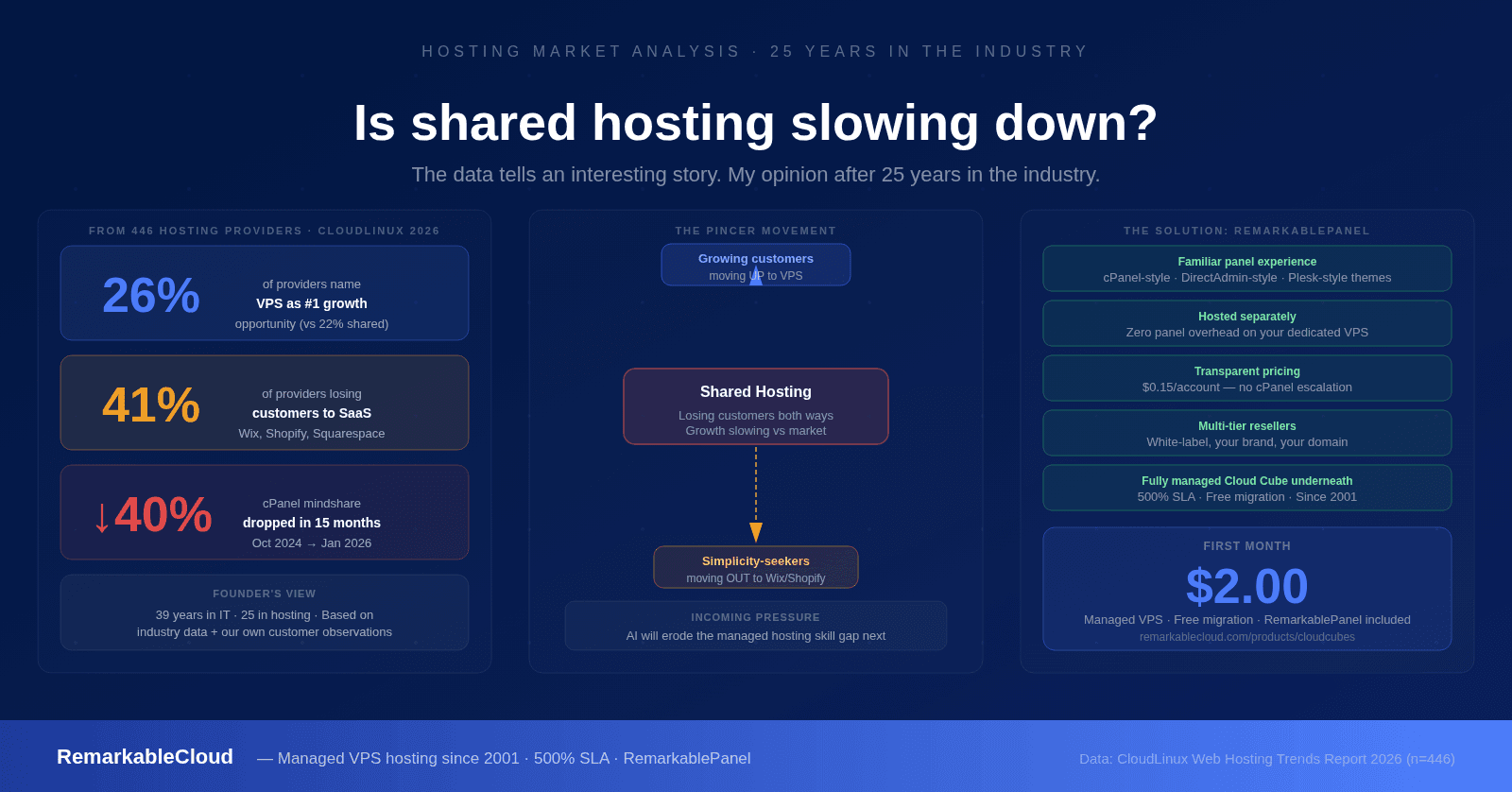
Is shared hosting slowing down? The data tells an interesting story.
I've been running a hosting company since 2001. In 25 years, I've watched the market through the rise of WordPress, the cPanel era, the cloud transition, and the first wave of managed hosting. I've seen segments grow fast, plateau, and get replaced. Structural shifts in this industry happen slowly, until they happen all at once.
What follows is my personal read of the market. It's based on three things: the CloudLinux Web Hosting Trends Report 2026, my own observations from running RemarkableCloud and watching our shared and reseller customer base over the past few years, and conversations with other hosting companies I consult for. I'm connecting dots that the data suggests but doesn't state outright. Reasonable people can read the same numbers differently. This is how I read them.
One concrete data point from our own business: in 2026 we stopped offering traditional reseller packages to new customers. That decision didn't come from theory: it came from watching the economics and the customer behavior over several years.
I'm not saying shared hosting is dead. I'm saying the signals are consistent enough that the next few years are worth watching carefully, and worth preparing for now.
I've been in IT for 39 years and in hosting specifically for 25. I mention that not as a credential but as context: when I read the data and it rhymes with something I've seen before, I take that seriously.
Two prior observations are worth naming because they're verifiable and relevant to how I'm reading the current signals. In the early 2000s I was arguing in Spanish-language hosting communities that shared hosting would eventually sell by resources (CPU, RAM, disk as quantified units) rather than the vague "unlimited" packages that were standard then. That's now the industry model. In 2010 I introduced Igor Seletskiy, founder of CloudLinux, to LiteSpeed. He had never heard of them.. I saw what the two could do together, reached out by email, opened a public feature request, and was the first to test the integration. LiteSpeed + CloudLinux is now the standard stack in shared hosting worldwide. I wrote no code. I just saw the connection before it was obvious.
The picture I'm seeing now is that shared hosting is losing its best customers from two directions simultaneously.
Sources and methodology
Primary data: CloudLinux Web Hosting Trends Report 2026: 446 hosting providers surveyed globally, Oct–Dec 2025. 58% were business owners, presidents, or C-level executives. Supplemented by RemarkableCloud's own customer observations and conversations with other hosting companies. Charts represent survey data directly. Interpretations and conclusions are mine.
What 446 hosting providers say about growth
When asked to identify their single biggest growth opportunity for the next two to three years, providers gave a clear answer:
VPS and dedicated hosting leads at 26%. Shared hosting is second at 22%. This isn't fringe opinion: this is what providers across every fleet size said when asked where the growth is coming from. VPS was the top growth bet in every segment, from companies with a handful of servers to those managing hundreds.
Shared hosting is still in the top two, which reflects its importance as a base product. But the direction of the industry's attention is shifting. The providers closest to the market are putting their growth bets on VPS, not on competing for the next shared hosting customer.
The gap between shared and VPS adoption is already only 7 percentage points. A few years ago it was far wider.
The threat nobody is talking about: SaaS platforms
The report asks providers why their customers churn. Price is the top answer at 56%, which is expected. But the second-most-cited reason surprised me when I first read it, and I suspect it will surprise you too.
41% of providers say customers are leaving for SaaS platforms: Wix, Shopify, Squarespace. This is almost as prevalent as price churn, and it represents a fundamentally different problem. You can't solve it by lowering your price. You can't solve it by improving uptime. The customer has decided they want a turnkey all-in-one product, and traditional hosting doesn't offer that by default.
This matters to the shared hosting thesis directly. The customers leaving for SaaS are typically the same profile as the core shared hosting customer: small businesses who want something simple that works, without managing a website stack. They're not moving up to VPS. They're moving out of the hosting ecosystem entirely.
Shared hosting is losing customers from two directions at once: the valuable ones moving up to VPS, and the simplicity-seekers moving out to SaaS.
The cPanel signal
The control panel landscape confirms the direction of travel. cPanel/WHM is still the dominant panel: 64% of providers in the CloudLinux survey use it. That's a large installed base with genuine stickiness. But the direction of movement is clear.
A few things stand out in this data beyond the headline numbers. 19% of providers already run custom or proprietary control panels. 20% offer no-panel servers for developers and technical customers. The diversification away from the traditional shared hosting panel stack is already well underway.
Now layer in the pricing signal. In 2019, cPanel moved from a flat per-server license to per-account pricing. I want to be precise about what this means strategically: companies with dominant market positions and deep installed-base lock-in don't change their monetization model from flat-fee to per-unit unless they believe the number of units is about to decrease or they need to extract maximum value before it does.
Per-account pricing is what you do when you're optimizing for extraction rather than adoption. It maximizes revenue from an existing base while making it more expensive to grow that base. That's the rational move for a company that reads the same data the rest of us are reading. cPanel's leadership understands this market better than almost anyone. Their pricing communicates their thesis.
cPanel and Plesk have been under the same ownership since 2018
WebPros was formed when Oakley Capital acquired Plesk in 2017 and cPanel in 2018, bringing both dominant traditional control panels under the same holding company. Oakley then sold WebPros to CVC in late 2019. The consolidation of the two market leaders happened seven years ago, well before the current signs of segment slowdown became visible. That timing matters: the consolidation preceded the pressure, which suggests it was strategic positioning rather than a reaction to it.
How providers are competing on VPS: the managed service opportunity
If VPS is where the growth is, how are providers winning in that space? The survey asks providers how they differentiate their VPS offerings. The answer matters for understanding where the market is going.
Only 14% of VPS providers compete primarily on price. 29% compete through fully managed service. 22% through superior 24/7 support. The VPS providers winning are not the cheapest ones: they're the ones that have understood what shared hosting customers actually wanted: managed infrastructure they don't have to think about.
This is the insight that drove everything we've built at RemarkableCloud. Shared hosting customers didn't choose shared hosting because they wanted shared resources and a neighbour risk. They chose it because it was the only affordable, managed, simple option. Now there's a better one.
What this means for the transition
The barrier to moving shared hosting customers to VPS was never price; that gap has largely closed. It was the interface. The shared hosting experience that customers knew: familiar panel layout, one-click WordPress, email accounts and DNS, all managed through a browser without touching a terminal. Moving to VPS used to mean trading that for a root prompt. That trade wasn't worth making for most small businesses even when the infrastructure was clearly better.
RemarkablePanel is our hosted control panel, built on the Enhance platform. Hosted means it runs on RemarkableCloud's shared infrastructure separately from your VPS; your server handles web serving, databases, and email, while the panel, DNS, and backup coordination run without consuming your dedicated resources.
Familiar panel, simple workflow, but with shared CPU, shared mail IP, neighbour risk, resource caps, and the structural limitations that drive 41% of customers toward SaaS or VPS.
Same familiar workflow, on dedicated resources, your own IP, no neighbours, no caps, fully managed. The shared hosting experience without the shared hosting constraints.
The first account is free with every Cloud Cube. Additional client accounts are $0.15/month each, with no per-account escalation, no equivalent of the cPanel pricing pressure that the survey data shows is reshaping how providers think about panels.
What this means for resellers and agencies
The report's data on professional services is particularly relevant for resellers and agencies. When asked how providers plan to increase ARPU in 2026, expanding professional services leads all other strategies at 50%. The modern hosting provider is evolving from an infrastructure landlord into a technical partner.
For agencies and resellers, this confirms what many are already discovering: the margin opportunity isn't in reselling cheaper shared hosting: it's in wrapping infrastructure in service and selling a managed outcome.
Host client sites on a managed VPS under your brand. Clients get a familiar cPanel-style, DirectAdmin-style, or Plesk-style interface. You control the infrastructure, RemarkableCloud manages the server.
When a client outgrows shared-tier performance, you move them to their own Cube. You own that conversation and that upgrade revenue.
Instead of reselling shared allocations at thin margins on infrastructure you don't control, you sell managed dedicated solutions. Multi-tier reselling is supported, so your clients can resell to their own customers.
20% reseller discount on all Cloud Cubes. Free first panel account. $0.15/account with no escalation.
The survey data is clear: providers are moving toward managed, service-led models as the path to sustainable margins. The VPS + managed panel combination is the product those customers are looking for.
The infrastructure is ready. The panel interface is ready. The market is moving.
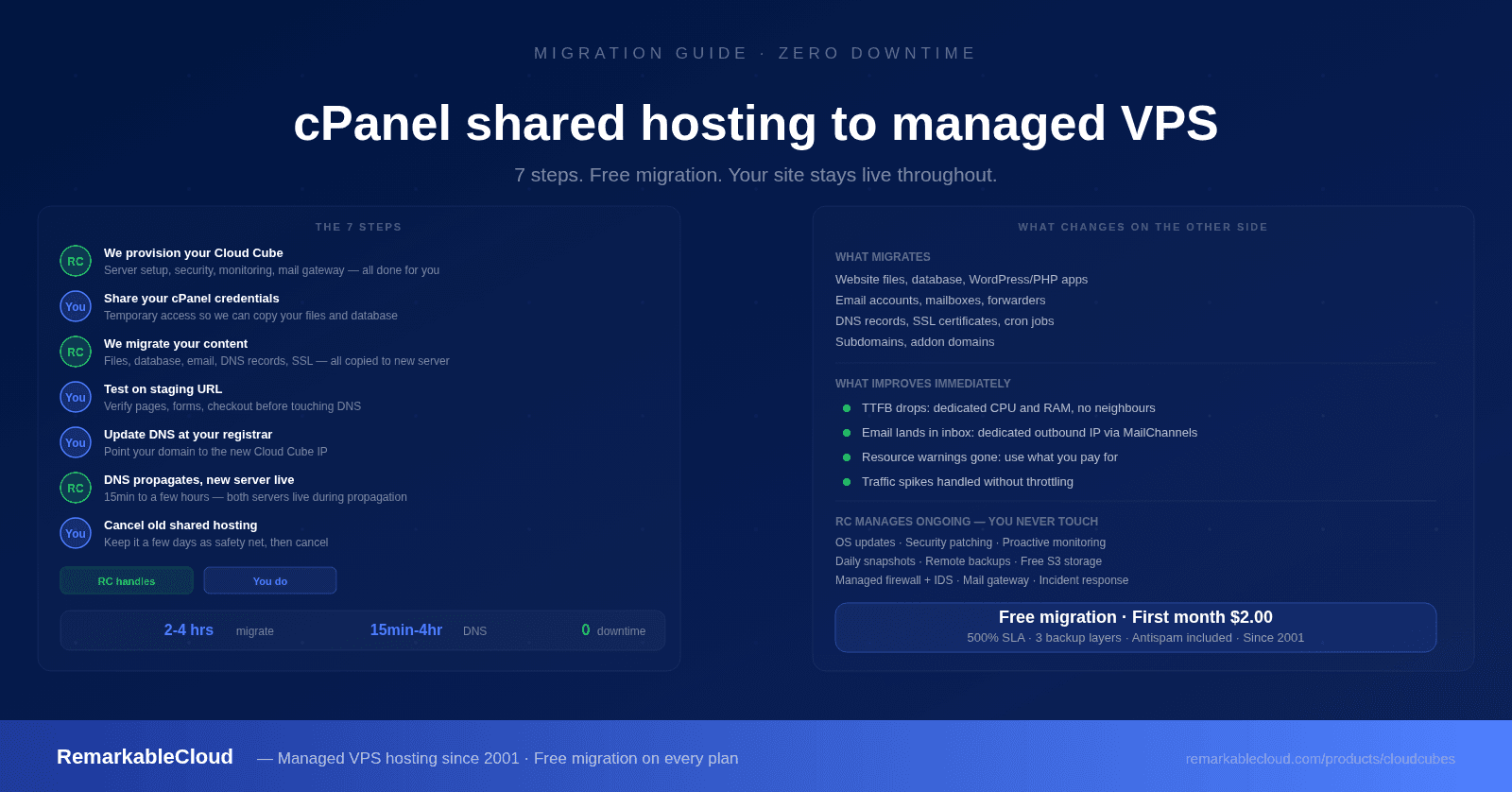
For businesses hitting shared hosting's resource limits, RemarkablePanel bridges the gap: dedicated VPS performance with the familiar panel workflow. Free migration on every Cloud Cube.
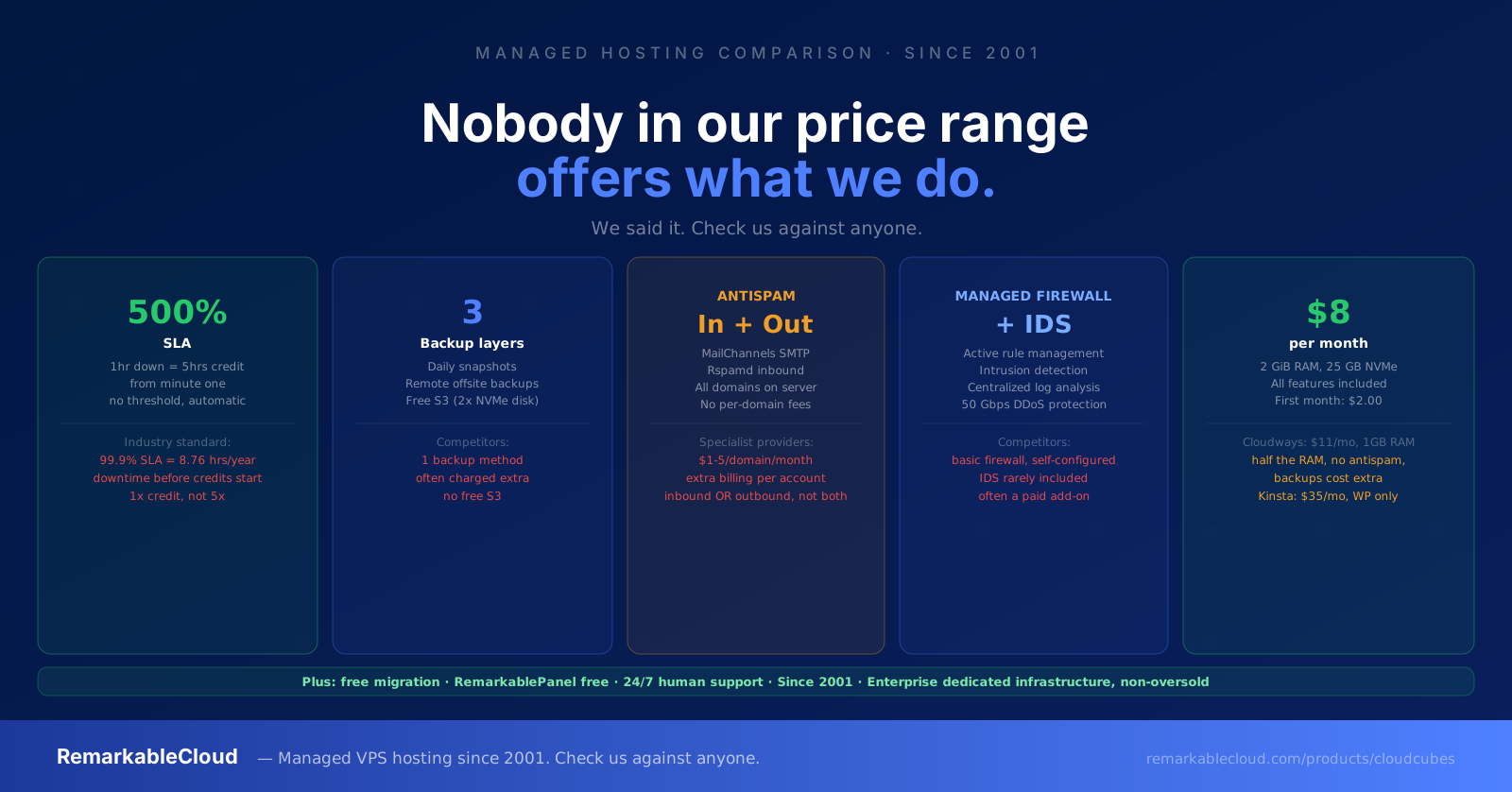
Same interface, dedicated resources, 500% SLA instead of a standard 99.9% uptime promise.
One more pressure point: AI is coming for the skill gap in managed hosting
I want to raise something that I don't see discussed honestly in our industry yet, because I think it's the most significant medium-term pressure on managed hosting specifically.
The traditional managed hosting value proposition has two components that are easy to conflate, but are actually very different:
- The skill gap: "You don't know how to run a Linux server, so we do it for you."
- The convenience gap: "You could figure it out, but you don't want this to be your problem."
AI is going to eat the skill gap significantly. Someone who could never configure a web server can now ask Claude to walk them through it. Someone who couldn't read an error log can paste it into an AI tool and get a plain-English diagnosis in seconds. The technical knowledge barrier that made managed hosting necessary for non-technical customers is coming down fast.
This will enable a new middle tier that doesn't fully exist today: "AI-assisted unmanaged" hosting at low cost. An unmanaged VPS provider with an AI support interface can reasonably offer customers a self-service experience that handles 80% of common issues without a human support team. The economics are dramatically better than running a support operation or outsourcing it. You'll see providers market this as "managed by AI," and for many customers, that will be good enough.
My honest assessment: the customers who are on managed hosting primarily because of the skill gap will migrate toward these offerings over the next few years. That's a meaningful slice of the current managed hosting customer base, and our industry needs to be honest about it rather than pretending AI won't change the value equation.
What survives? The convenience gap. And I'd argue it's more durable than it looks.
Even with AI assistance, "managing with AI" still means you're the one who has to notice the problem at 3am, decide whether the AI's suggested fix is correct before applying it to a production server, carry the accountability to your clients for whatever happens, and spend your time on it regardless of how much AI shortens the task. That's not the same as the problem not being yours. The appeal of managed hosting at its core isn't "someone else has the skills": it's "someone else has the problem."
AI doesn't watch your server proactively. It doesn't credit you five hours when you're down for one. It doesn't have a 25-year track record with your infrastructure. It answers when you ask. That's valuable, but it's different from what a managed host provides.
My view is that managed hosting needs to evolve its positioning from "we have skills you don't" to "we take on responsibility you don't want." The first argument is weakening. The second one isn't. The industry shift toward fully managed services as the primary VPS differentiator (confirmed at 29% in the CloudLinux survey) suggests the better providers are already moving in this direction, whether consciously or not.
AI will eliminate the skill gap in server management. The convenience gap is a different thing entirely, and it's what managed hosting should be selling.
Where this goes
Shared hosting will persist. The segment that buys $3/month hosting for a brochure site will exist for years. But that's not the customer that builds a hosting business around. The 2026 data from 446 providers confirms what I see in our own customer base: the valuable customers are moving up the stack, VPS is where providers are putting their growth bets, and the panel experience that kept customers on shared hosting is now available on dedicated infrastructure.
The question isn't whether this shift is happening. It's whether you're positioned ahead of it or behind it.
RemarkablePanel is free with every Cloud Cube. First month from $2. Free migration from shared hosting.
See Cloud Cube plans →The shared hosting experience, on infrastructure that scales
RemarkablePanel on a managed Cloud Cube: dedicated resources, familiar panel, 500% SLA, fully managed. Free first account. $0.15/month per additional account.
See Cloud Cube plans