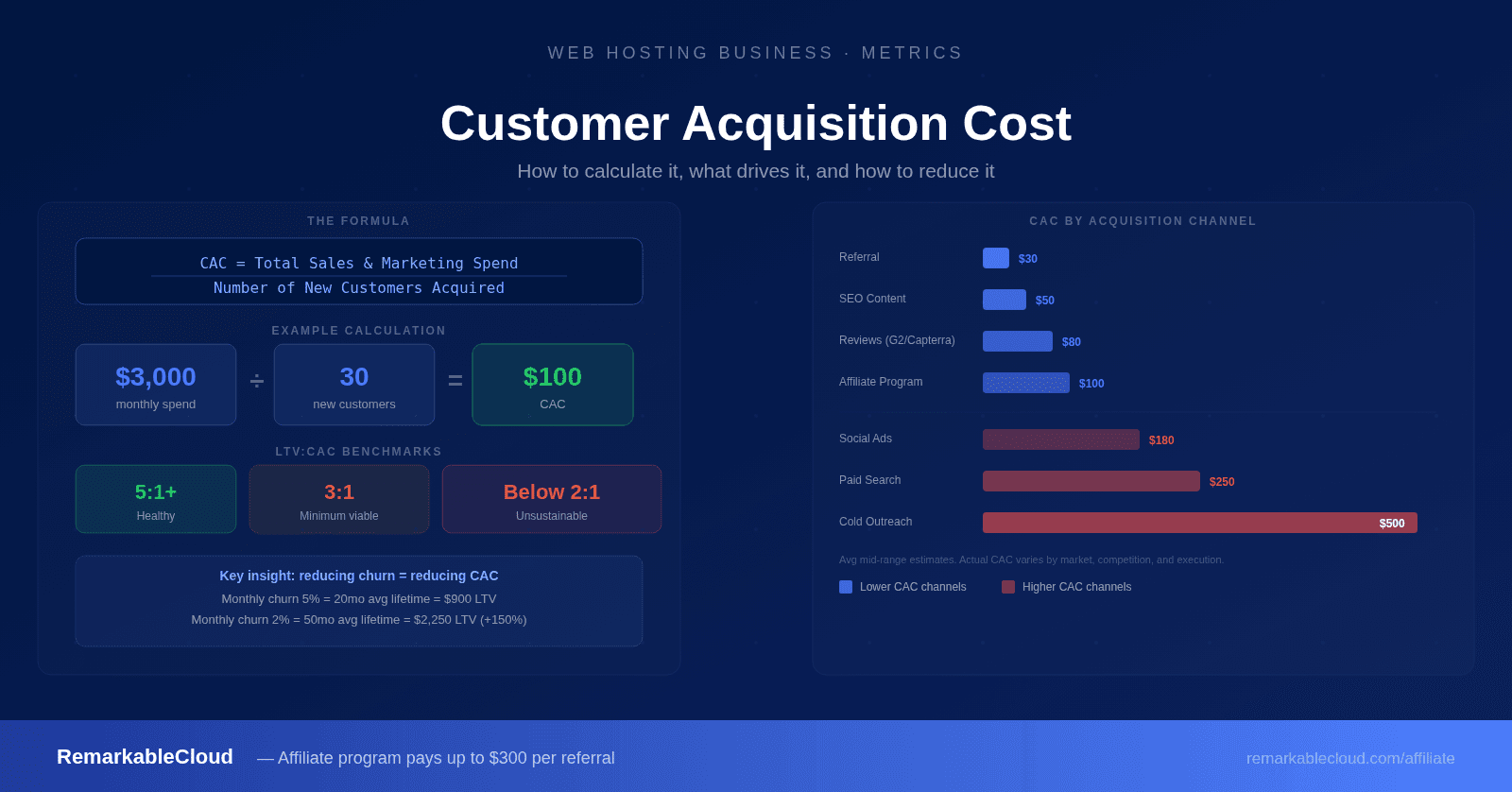
Customer Acquisition Cost in the web hosting business
Customer Acquisition Cost (CAC) is the total amount you spend to win one new paying customer. For web hosting businesses, where customer lifetime value can span years and margins compound with scale, CAC is one of the most important numbers to understand, track, and actively reduce.
This article covers what CAC means in the context of web hosting, how to calculate it correctly, what drives it up, and the specific tactics that keep it low while maintaining growth.
- CAC is total sales and marketing spend divided by new customers acquired in the same period
- In web hosting, a healthy LTV:CAC ratio is 3:1 or better — meaning each customer earns you at least 3× what they cost to acquire
- Affiliate programs, SEO content, and referral programs are the lowest-CAC acquisition channels for hosting businesses
- Free migration and strong onboarding directly reduce CAC by improving trial-to-paid conversion
- Reducing churn is mathematically equivalent to reducing CAC — it extends LTV without any additional acquisition spend
What is Customer Acquisition Cost?
CAC represents the full cost of acquiring a customer, not just the ad spend. The formula is straightforward:
What counts as sales and marketing spend depends on what you include. A narrow definition captures only paid advertising. A comprehensive and accurate definition includes:
- Paid advertising (Google Ads, Meta, display, retargeting)
- Content marketing costs (writers, designers, SEO tools)
- Affiliate commissions paid
- Sales team salaries and commissions (if applicable)
- Marketing software and platform costs
- Promotional discounts given to acquire customers (e.g., first-month free offers)
- Events, sponsorships, and trade shows
For web hosting companies at the early stage, a simplified calculation using direct marketing spend is a reasonable starting point. As the business scales, including all overhead costs gives a more accurate picture of profitability.
A practical example
If you spent $3,000 on marketing in January and acquired 30 new paying customers, your CAC for that month is $100. If your average customer pays $20/month and stays for 18 months, their Lifetime Value (LTV) is $360 — giving you a 3.6:1 LTV:CAC ratio. That's a healthy business.
What drives CAC in web hosting
Web hosting is a competitive market with a few structural factors that influence CAC more than in most industries.
High commoditization at the low end
Shared hosting has become a commodity. When dozens of providers offer plans at $3–$10/month with similar feature lists, competing on price or features alone drives CAC up because every competitor is running the same ads against the same keywords. Differentiating on positioning — managed vs unmanaged, specialist vs generalist — is the most reliable way to reduce CAC in a commodity market.
Long consideration cycles for higher-value plans
A buyer choosing between $3/month shared hosting plans makes a decision quickly. A business evaluating managed VPS options at $30–$100/month researches for weeks. This extends the time between first touch and conversion, which increases the number of marketing touchpoints required per acquisition and therefore the CAC.
High lifetime value justifies higher CAC
The good news is that web hosting customers who stay tend to stay for years. A managed hosting customer who pays $50/month for three years generates $1,800 in revenue. A CAC of $100–$200 is entirely sustainable at that LTV. The goal isn't the lowest possible CAC — it's the best LTV:CAC ratio.
CAC by acquisition channel: what the numbers look like
| Channel | Typical CAC range | LTV:CAC at $50/mo, 24mo LTV | Notes |
|---|---|---|---|
| SEO / organic content | $20–$80 | 15:1 to 60:1 | High upfront cost, compounds over time |
| Affiliate program | $50–$150 | 8:1 to 24:1 | Fixed cost per conversion, highly predictable |
| Referral / word of mouth | $10–$50 | 24:1 to 120:1 | Lowest CAC channel, hardest to scale |
| Paid search (Google Ads) | $100–$400 | 3:1 to 12:1 | Competitive, instant traffic, stops when budget stops |
| Social media ads | $80–$300 | 4:1 to 15:1 | Works for brand building, less for direct conversion |
| Review platforms (G2, Capterra) | $40–$120 | 10:1 to 30:1 | High-intent traffic from comparison searches |
| Cold outreach / SDR | $200–$800 | 1.5:1 to 6:1 | Works for enterprise; rarely viable for SMB hosting |
The pattern is consistent: channels where you create lasting assets (content, reviews, affiliate relationships) have dramatically lower long-run CAC than channels where you pay per click. For web hosting businesses at any stage, investing in SEO content and an affiliate program before scaling paid ads is the highest-return sequence.
The LTV:CAC ratio: the number that actually matters
CAC in isolation tells you very little. A $200 CAC is terrible if the customer only stays for 2 months. It's excellent if they stay for 5 years. The LTV:CAC ratio is the metric that contextualizes both:
For a managed hosting business where average plan value is $45/month and average customer lifetime is 30 months:
- LTV = $45 × 30 = $1,350
- At CAC of $150: LTV:CAC = 9:1 (excellent)
- At CAC of $450: LTV:CAC = 3:1 (minimum viable)
- At CAC of $700: LTV:CAC = 1.9:1 (unsustainable)
This is why managed hosting has fundamentally better unit economics than commodity shared hosting. Higher plan values and longer customer lifetimes mean you can afford a higher CAC to acquire the right customers.
Strategies to reduce CAC in web hosting
Build SEO content before scaling paid ads
Comparison articles, "best managed hosting" roundups, migration guides, and technical tutorials attract visitors with buying intent at a fraction of the cost of paid search. A well-ranking article continues generating leads for years after it's published. For a hosting business, the category of content that converts most reliably is comparison content — "Cloudways vs managed VPS", "cPanel alternatives", "DigitalOcean vs managed hosting" — because visitors searching these terms are actively evaluating options.
Launch an affiliate program before you need it
An affiliate program converts your happiest customers and relevant content creators into a sales channel that pays only on successful conversions. There's no wasted spend — every commission paid is attached to an acquired customer. The CAC is fixed, predictable, and entirely performance-based. For RemarkableCloud specifically, the affiliate program pays up to $300 per referred customer, which works out to a CAC well within the LTV:CAC thresholds above for managed VPS plans.
RemarkableCloud's affiliate program pays $12.50 per GB of RAM purchased, up to $300 per referral. Fixed CAC, performance-based, no wasted spend.
Join the affiliate program →Reduce friction at the conversion point
Free migration removes the single biggest objection in hosting purchases: "I don't want to deal with moving everything." When migration is free and handled by the host, conversion rates improve and you acquire customers who would otherwise stay on a worse platform because moving is too painful. This directly reduces CAC by improving the conversion rate from prospect to customer without changing acquisition spend.
Use first-month pricing strategically
A 75% discount on the first month (the RemarkableCloud model) reduces the initial financial commitment that blocks conversions. A prospect who isn't sure about committing to $36/month will often take a $9 trial. The CAC of this customer includes the foregone revenue from the discount — but if they stay, the LTV math works out significantly in your favor.
Invest in retention — it's equivalent to reducing CAC
Extending customer lifetime directly improves the LTV:CAC ratio without spending a dollar on acquisition. A customer who stays 36 months instead of 24 increases LTV by 50%. Achieving that through better support, proactive monitoring, and reliable infrastructure costs far less than acquiring a replacement customer. For managed hosting specifically, reducing churn is the highest-ROI activity in the business after the initial customer base is established.
Build a review presence on comparison platforms
Listings on G2, Capterra, HostAdvice, and TrustRadius attract high-intent visitors who are actively comparing options. The CAC from these channels is low because the visitors are already in buying mode. Getting existing customers to leave honest reviews is a one-time investment that reduces acquisition cost for years.
Measuring CAC correctly over time
One measurement error that distorts CAC calculations: mixing acquisition costs with retention costs. Renewal campaigns, upsell emails, and support costs should not be included in CAC — they're retention costs and belong in a separate calculation. Including them inflates your CAC and makes it appear that acquiring customers costs more than it does.
Track CAC separately by channel from day one. The total blended CAC tells you whether the business is profitable. Per-channel CAC tells you where to allocate budget. A business running SEO, affiliate, and paid search together might have a blended CAC of $120 — but SEO alone might be $40, affiliate $100, and paid search $350. Without the per-channel breakdown, you can't make rational budget decisions.
Infrastructure that improves your CAC economics
Free migration removes the biggest objection. 500% SLA reduces churn. RemarkablePanel enables white-label reselling. RemarkableCloud's managed VPS improves every part of the hosting business equation. From $2 your first month.
See what's included