
Drupal installer flaw CVE-2026-132165 is under attack: patch and block install.php
On this page
Update, November 26, 2026: Drupal published a second installer advisory on November 25, SA-CORE-2026-019, for CVE-2026-136716, which it says is also being exploited. Some sites in unusual install states stayed exposed on 10.6.22, 11.3.22 and 11.4.13; the fixed releases are now 10.6.23, 11.3.23 and 11.4.14, followed by the database updates. Details and checks: Drupal CVE-2026-136716, the second installer fix.
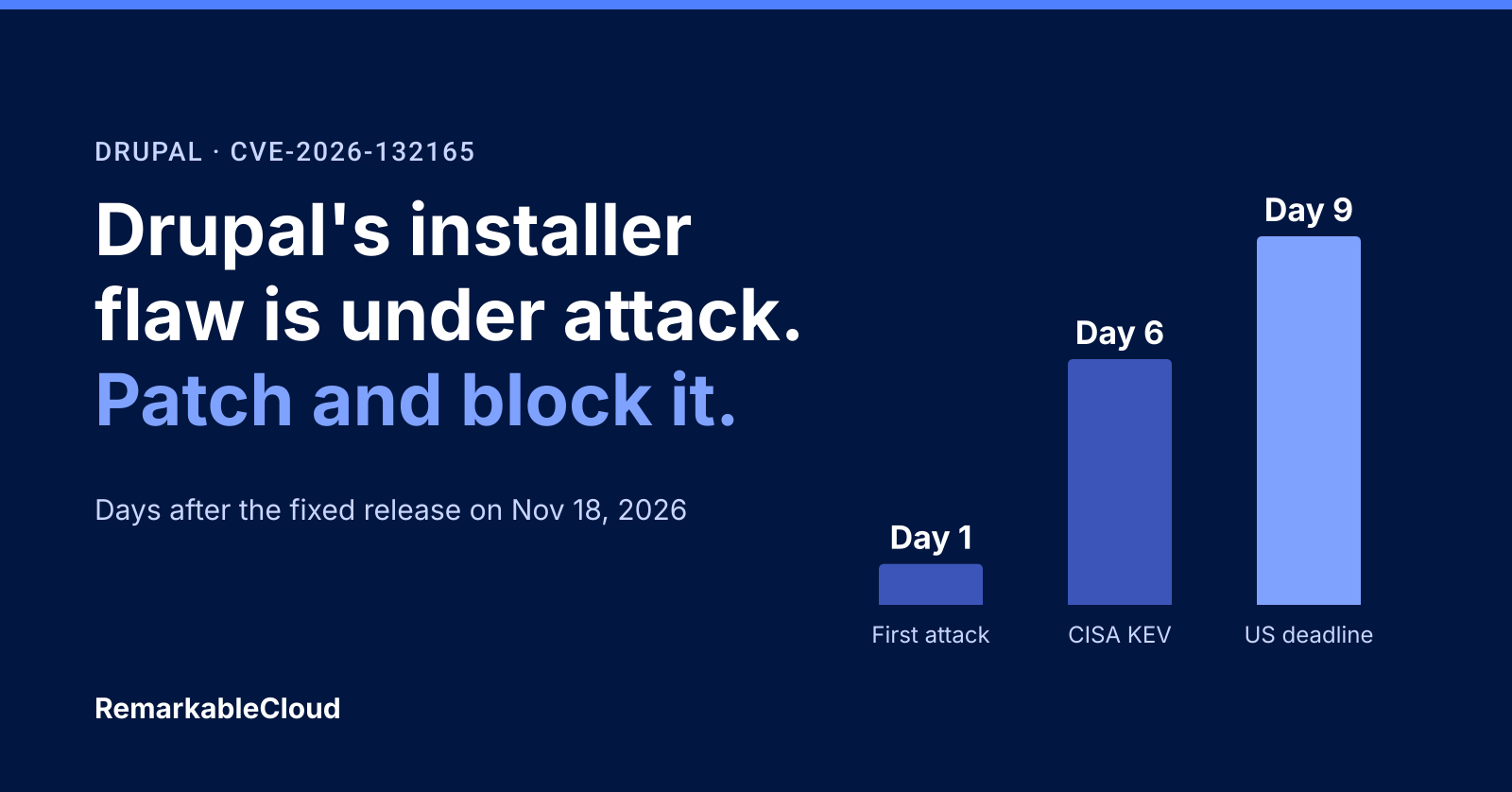
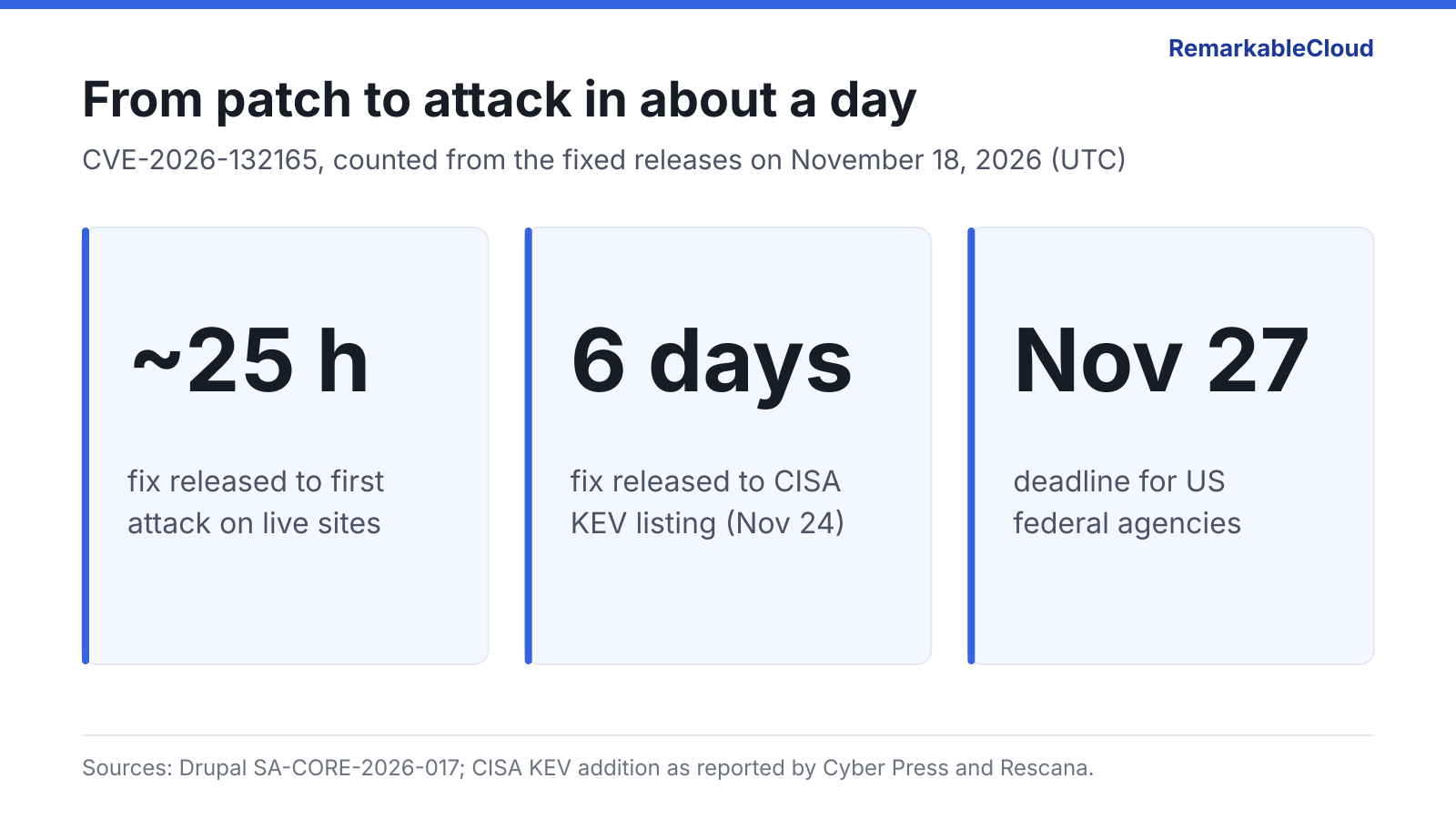
Drupal core’s installer flaw, CVE-2026-132165, is being exploited: Drupal’s Security Team received a report of attacks on live sites starting November 19, 2026 at 19:00 UTC, about 25 hours after the fixed releases shipped. CISA added it to its Known Exploited Vulnerabilities catalog on November 24. The fix is Drupal 10.6.22, 11.3.22 or 11.4.13, plus a web server rule that keeps /core/install.php closed.
Drupal rates the flaw Highly critical, 20 out of 25 on its own risk scale. Under specific conditions, an anonymous visitor can use the installer to try to reinstall a Drupal site that is already running, which can hand them control of the site and code execution on the server.
This article covers what happened, which versions are affected, how to check a site, and how to patch or block the installer, with the commands.
What happened, and how fast?
| Date (UTC) | Event |
|---|---|
| November 16, 2026 | Drupal announces critical core releases for November 18 and warns that exploits might be developed within hours or days |
| November 18, 2026, 17:43 | SA-CORE-2026-017 published; fixed releases 10.6.22, 11.3.22 and 11.4.13 |
| November 19, 2026, 19:00 | First reported exploitation on live sites, about 25 hours after the advisory |
| November 21, 2026 | Latest update to the advisory, which now reports the exploitation and a risk score of 20 of 25 |
| November 24, 2026 | CISA adds CVE-2026-132165 to the Known Exploited Vulnerabilities catalog |
| November 27, 2026 | Patch deadline for US federal civilian agencies |
Drupal gave two days of warning. Its November 16 public service announcement said the releases would land on November 18 between 17:00 and 21:00 UTC, that at least one flaw could be exploited by anonymous users, and that exploits might be developed within hours or days. That is close to what happened.
The flaw was found by Anthropic’s OSS Scanner, according to the advisory. Customers of Drupal Steward, the Drupal Security Team’s web application firewall service, were already protected against the known attack paths.
Public details are thin. Neither the advisory nor the news reports we read name the attackers, count the victims or describe what the attackers do once inside.
Which Drupal versions are affected?
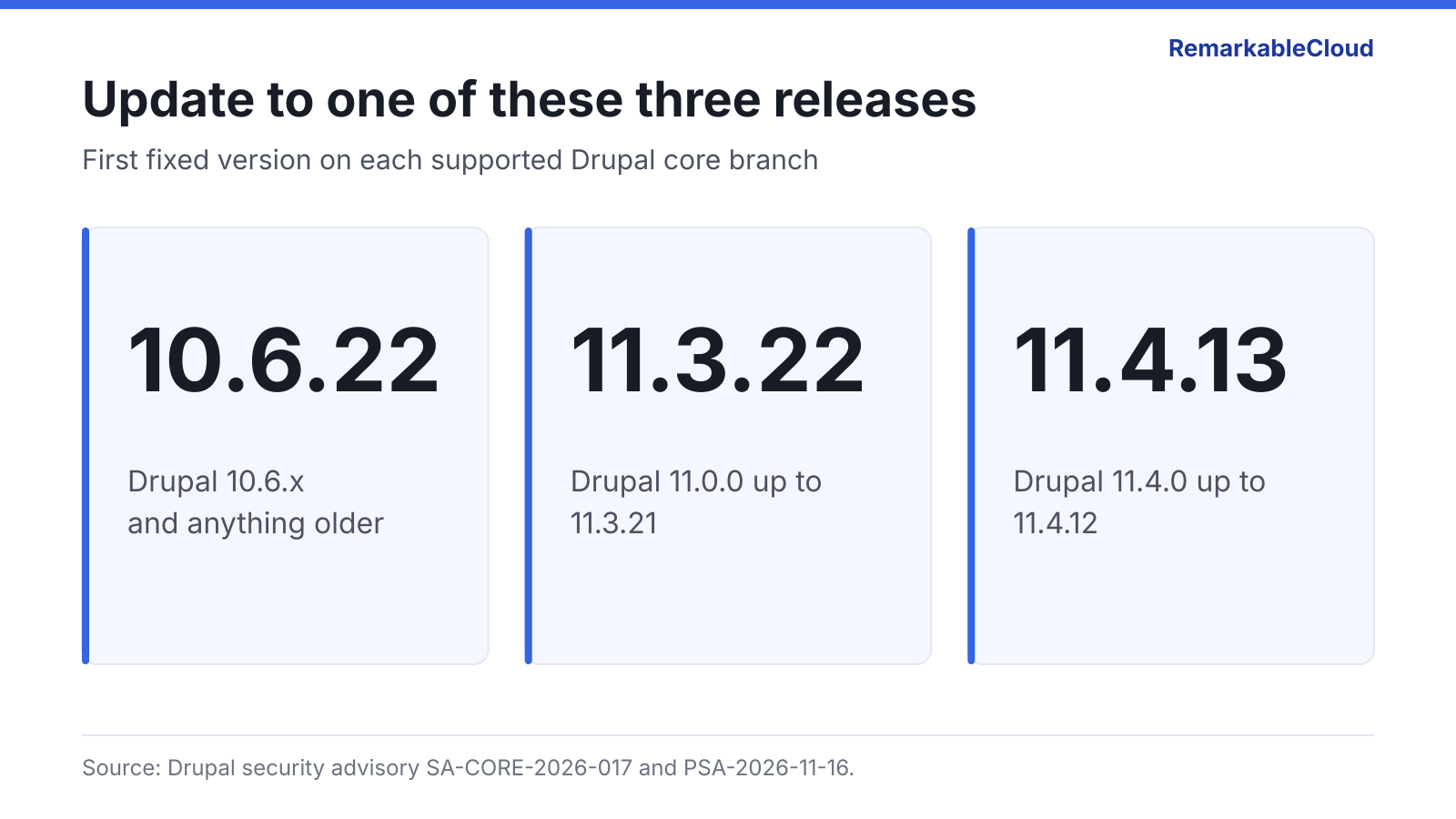
| If your site runs | Update to |
|---|---|
| Any release before 10.6.22 | 10.6.22 |
| 11.0.0 up to 11.3.21 | 11.3.22 |
| 11.4.0 up to 11.4.12 | 11.4.13 |
Every supported branch was affected. The installer, core/install.php, stays on a site after installation, and Drupal’s default .htaccess rules do not block it, as The Hacker News noted. Not every site is exploitable: the advisory’s own score marks the needed configuration as uncommon. Since nobody has published which configurations those are, treat any public Drupal site as exposed until it is patched.
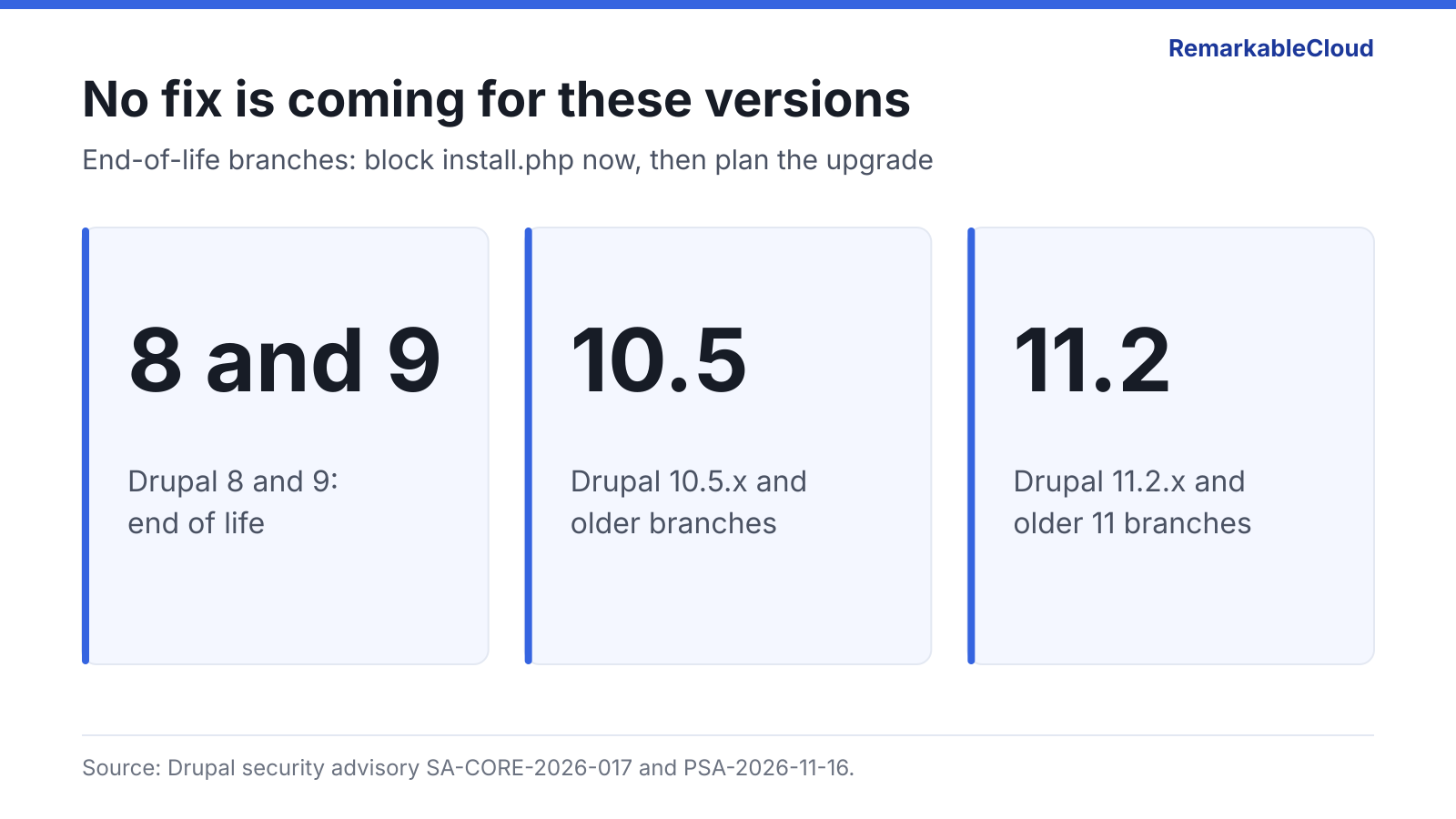
| Branch | Fix available? |
|---|---|
| Drupal 8 and 9 | No, end of life |
| Drupal 10.5.x and older 10 branches | No, end of life (move to 10.6.22) |
| Drupal 11.2.x and older 11 branches | No, end of life (move to 11.3.22 or 11.4.13) |
If a site sits on one of these branches, blocking the installer is the only protection until it is upgraded. The Hacker News also points out that, under an earlier Drupal announcement, the 11.3.x branch and Drupal 10 lose security coverage in December, so 10.6.22 and 11.3.22 are short stops.
How serious is it?
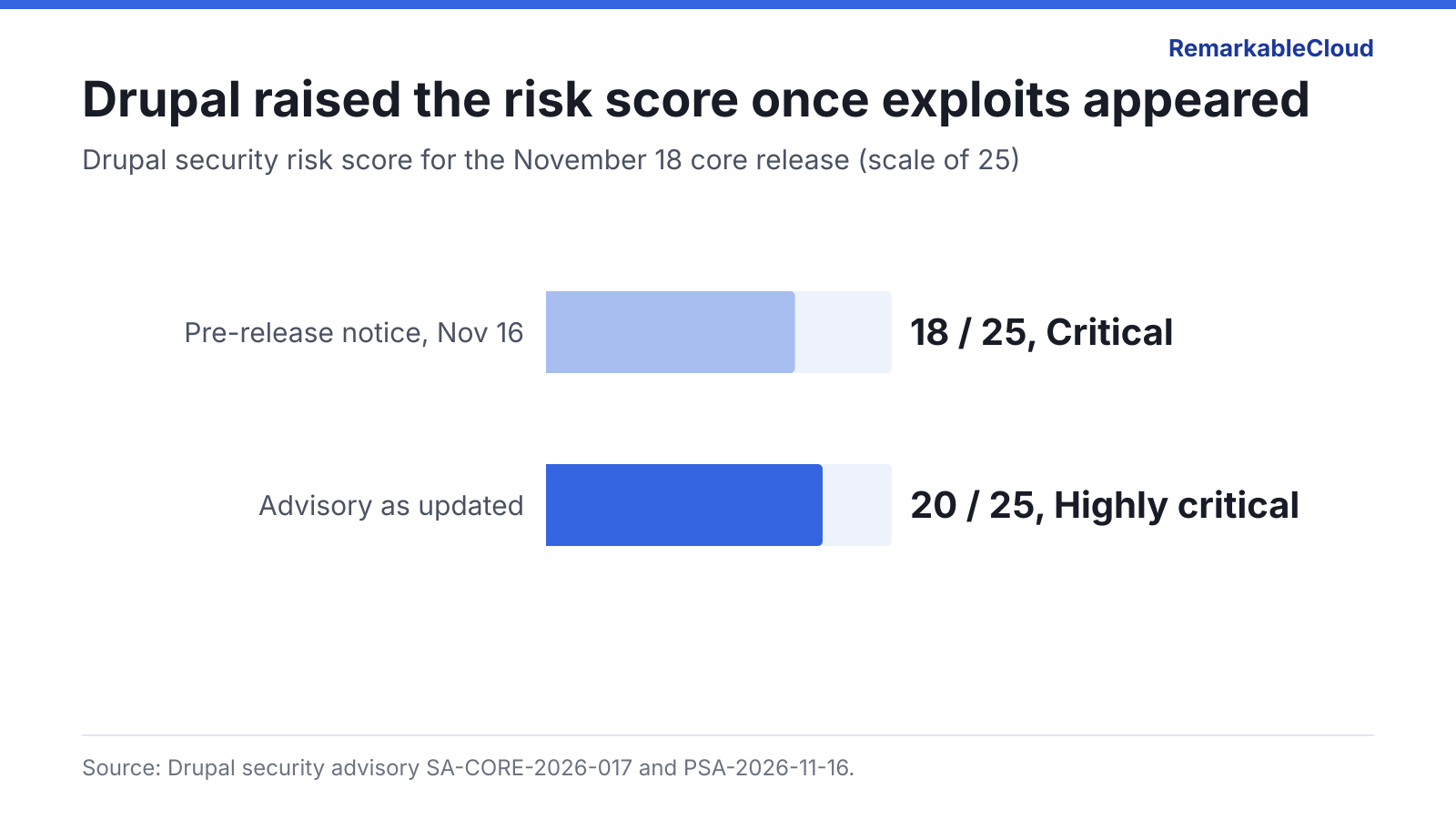
| Drupal notice | Risk score | Exploit field |
|---|---|---|
| PSA-2026-11-16, before release | 18 of 25, Critical | Proof of concept |
| SA-CORE-2026-017, as updated | 20 of 25, Highly critical | Exploit |
Drupal scores flaws on its own 25-point scale, not CVSS, and NVD had not published a CVSS score when Horizon3.ai wrote up the flaw on November 19. The score rose from 18 to 20 because the “exploit” factor moved from a proof of concept to a working exploit. The impact fields were already at their worst: full loss of confidentiality and integrity, no login needed.
How do I check if my site is affected?
First, the core version. Use Drush or Composer from the site’s root (often the folder that holds web/), or open Reports, Status report (/admin/reports/status) in the Drupal admin.
drush status --field=drupal-version
composer show drupal/core | grep versions
Second, whether the installer answers. Each of these should return 403 or 404. A 200 means the installer is reachable.
curl -I https://example.com/core/install.php
curl -IL https://example.com/install.php
curl -I https://example.com/core/install.php/foo
Third, if the site was unpatched after November 19, look for signs that someone already used the flaw: database settings in settings.php that you did not set, and administrator accounts you do not recognize.
How do I patch or block it?
1. Update core. On a Composer-managed site, take a backup or snapshot first, then update the core packages and run the database updates. The installer block below does not get in the way of updates; update.php is a separate script, and Drush does not use install.php at all.
composer update "drupal/core-*" --with-all-dependencies
drush updatedb
drush cache:rebuild
drush status --field=drupal-version
2. Block the installer in the web server, even after updating. This is Drupal’s recommended option. For nginx, inside the HTTPS server block (Drupal’s guide says not to use an exact location = match):
location ^~ /core/install.php {
  return 404;
}
For Apache, in the server or virtual host config, not in .htaccess, where Drupal says this block causes a 500 error:
<Location "/core/install.php">
  Require all denied
</Location>
Test and reload:
sudo nginx -t && sudo systemctl reload nginx
sudo apachectl configtest && sudo systemctl reload apache2
On shared or managed hosting where you only control .htaccess, Drupal’s guide gives a <Files "install.php"> rule with Require all denied instead, appended through Composer scaffold so core updates do not overwrite it. A third option is removing the file in Composer’s post-install-cmd and post-update-cmd scripts; Composer restores it on every core update, so the script has to run every time.
3. Lock down settings.php. The advisory says some, but not all, attack paths are closed if the web server cannot write to settings.php or change its permissions. That means read-only permissions and an owner other than the web server user (www-data, nginx or apache, depending on the system):
stat -c '%U %a %n' web/sites/default/settings.php
chmod 444 web/sites/default/settings.php
4. Run the curl checks again and confirm drush updatedb or /update.php still works.
How this works on a RemarkableCloud server
Every server we sell is fully managed at no extra cost, and we configure and support everything we install on it. For a flaw like this one, our agents detect newly reported vulnerabilities, measure which servers are actually exposed, put preventive measures in place before a patch exists, and roll out patches after testing them on a dev box and on canary servers. The managed firewall and IDS run on centralized log analysis and live threat data, and every server takes a daily snapshot, with extra snapshots free before a change.
Updating Drupal core touches your site’s code and dependencies, so we do it with you. If you run Drupal on one of our servers and want help checking the version, updating core or blocking the installer, open a ticket. For the bigger picture on how fast new flaws get used, read how fast attackers exploit new vulnerabilities, or see what our managed VPS includes.
Methodology
- Flaw, versions and score: Drupal’s advisory SA-CORE-2026-017 (published November 18, 2026, updated November 21) and PSA-2026-11-16, read on November 25, 2026. The 25-hour figure is the gap between the advisory’s publication time (17:43 UTC on November 18) and the first exploitation time the advisory reports (19:00 UTC on November 19).
- Exploitation: the only first-hand report is the advisory’s update, which says the Security Team “received a report” of exploitation on live sites. No observer, attacker or victim count has been published. Early write-ups from November 19 (The Hacker News, BleepingComputer, Horizon3.ai) predate that update and say no exploitation had been reported.
- CISA listing: we could not load CISA’s own pages for this run. The November 24 addition and the November 27 federal deadline come from Cyber Press and Rescana, which agree with each other.
- Commands and rules: the nginx, Apache, curl and Composer details come from Drupal’s “Securing the installer” guide (updated November 21, 2026). The version checks use standard Drush and Composer commands.
Questions and answers
What is CVE-2026-132165?
A flaw in Drupal core's installer, install.php. Under specific conditions, an anonymous attacker can use the installer to try to reinstall an existing Drupal site, which can give them control of the site and code execution. Drupal rates it Highly critical, 20 out of 25.
Is CVE-2026-132165 being exploited?
Yes. Drupal's Security Team received a report of exploitation on live sites from November 19, 2026 at 19:00 UTC, about 25 hours after the fixed releases. CISA added it to its Known Exploited Vulnerabilities catalog on November 24, 2026.
Which Drupal versions fix CVE-2026-132165?
Drupal 10.6.22, 11.3.22 and 11.4.13. Every release before 10.6.22, 11.0.0 up to 11.3.21 and 11.4.0 up to 11.4.12 is affected. Drupal 8, 9, 10.5.x and older, and 11.2.x and older get no fix.
How do I block install.php in Drupal?
Drupal recommends a web server rule: in nginx, a location block for /core/install.php that returns 404; in Apache, a Location block with Require all denied in the server config. Blocking install.php does not affect updates, which run through update.php or Drush.
Is blocking install.php enough on its own?
No. It is a workaround, not a fix. Update to a fixed release, keep the installer blocked afterwards, and make sure the web server cannot write to or change the permissions of settings.php.
Sources and references
- Drupal, SA-CORE-2026-017: Drupal core, remote code execution · drupal.org
- Drupal, PSA-2026-11-16: upcoming critical Drupal core releases · drupal.org
- Drupal, securing the installer (install.php) · drupal.org
- Cyber Press, CISA warns of exploited Drupal, ASP.NET and Optimizely flaws (November 25, 2026) · cyberpress.org
- Rescana, Drupal core installer flaw exploited and in CISA KEV (November 24, 2026) · rescana.com
- The Hacker News, Drupal patches critical installer flaw (November 19, 2026) · thehackernews.com
- BleepingComputer, Drupal patches critical RCE flaw (November 19, 2026) · bleepingcomputer.com
- Horizon3.ai, CVE-2026-132165: Drupal core installer RCE (November 19, 2026) · horizon3.ai