
DDoS in 2026: record attacks are huge, but most are small and short
On this page
- Record attacks grew almost 5x in 2025
- Network-layer attacks tripled in 2025
- Most attacks are small and over in minutes
- Over before anyone can react
- What protection actually covers
- Server-side checks and limits
- How this works on a RemarkableCloud server
- Methodology
- Questions and answers
- Sources and references
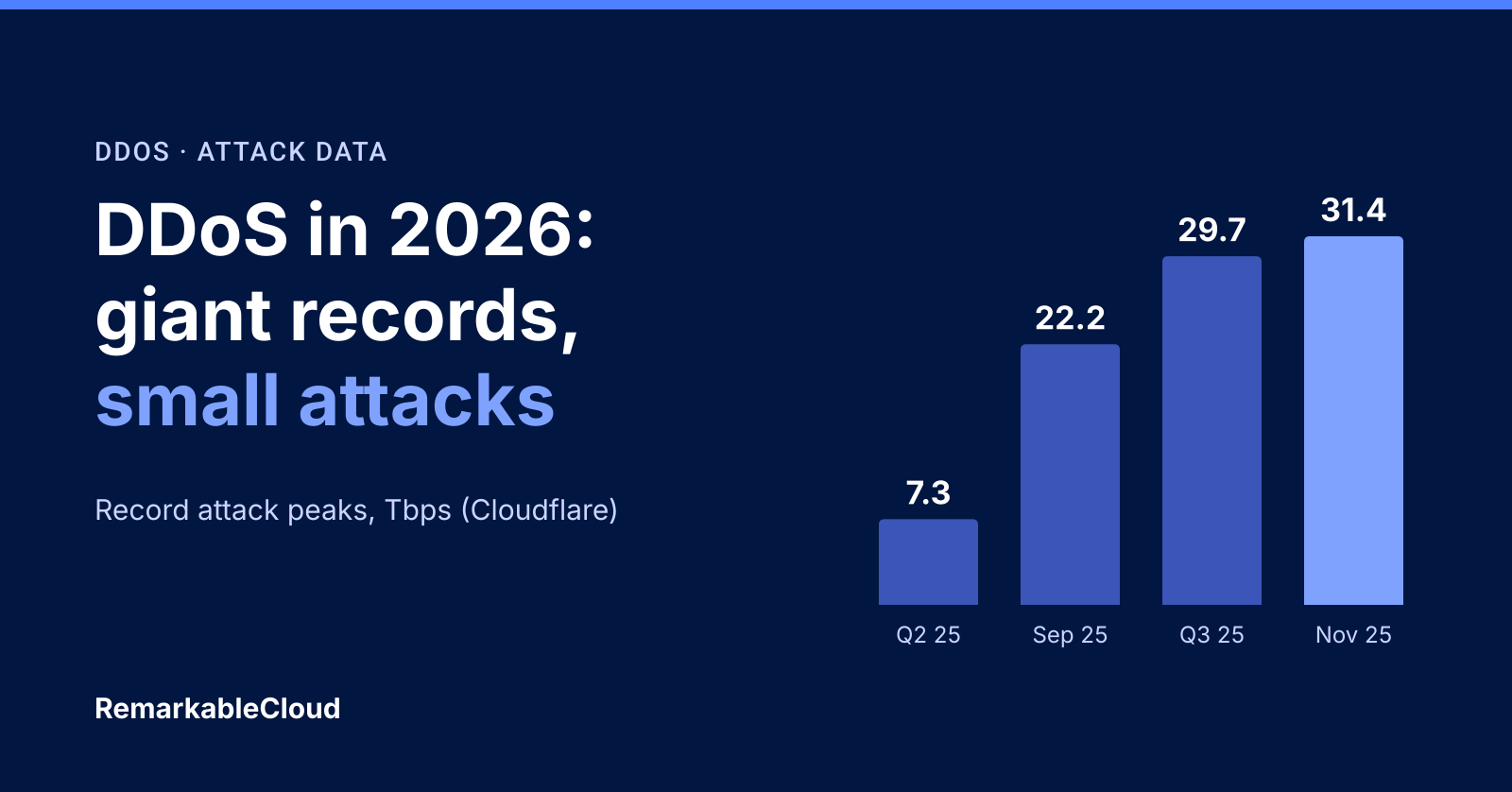
DDoS headlines are about records. In November 2025, Cloudflare mitigated an attack that peaked at 31.4 terabits per second and lasted 35 seconds. Six months earlier the record had been 6.5 Tbps.
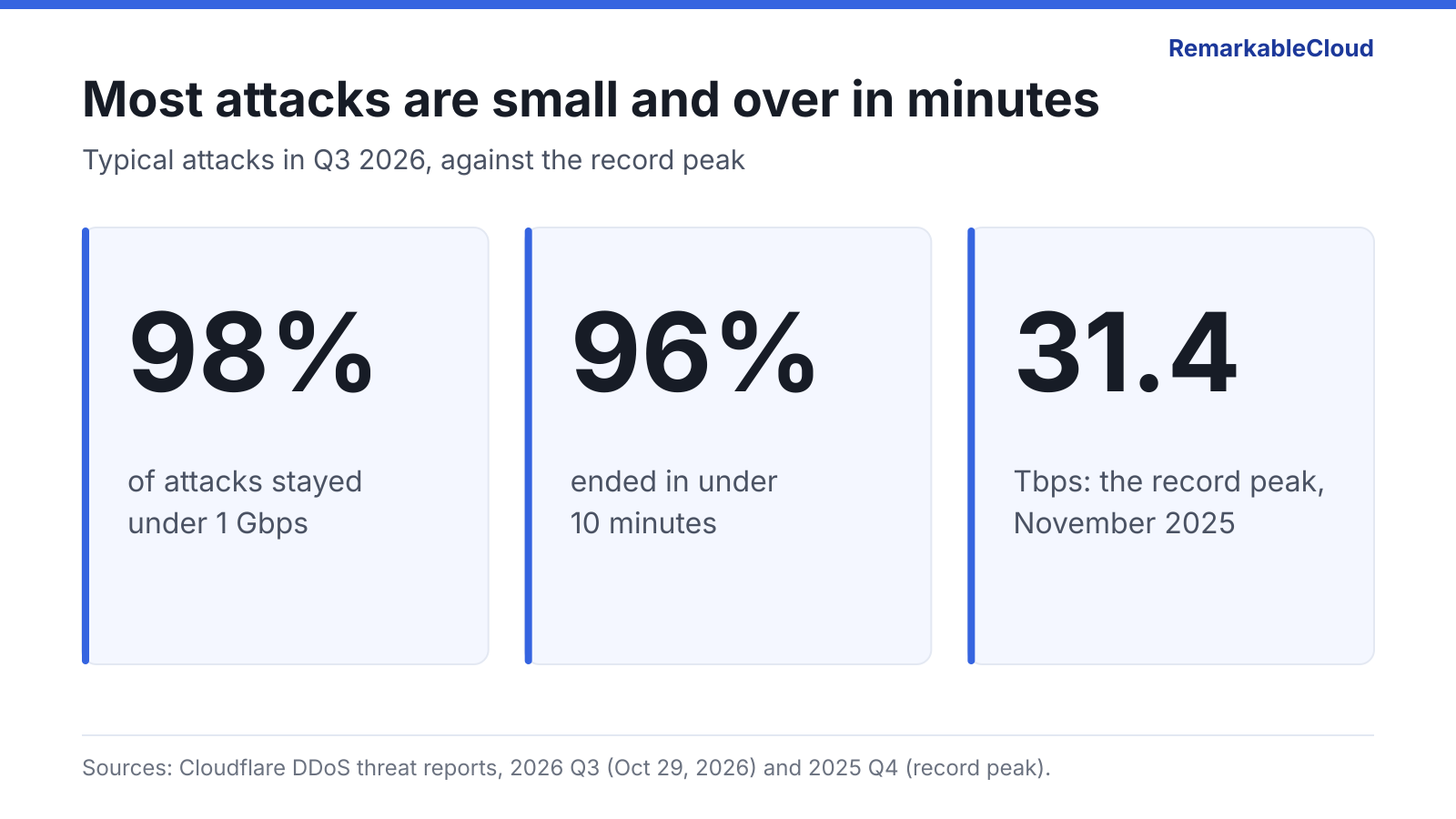
The attacks most sites actually face look nothing like that. In the third quarter of 2026, 98% of the attacks Cloudflare saw stayed under 1 gigabit per second, and 96% were over in under 10 minutes. Cloudflare’s own comment on that 1 Gbps figure: “more than enough to overwhelm a server or website”.
So the useful question for a site owner is not whether you could survive a record attack. It is whether something stops the small, short, common one before your visitors notice. Here is what the 2025 and 2026 data shows, and what you can do at the server and above it.
Record attacks grew almost 5x in 2025
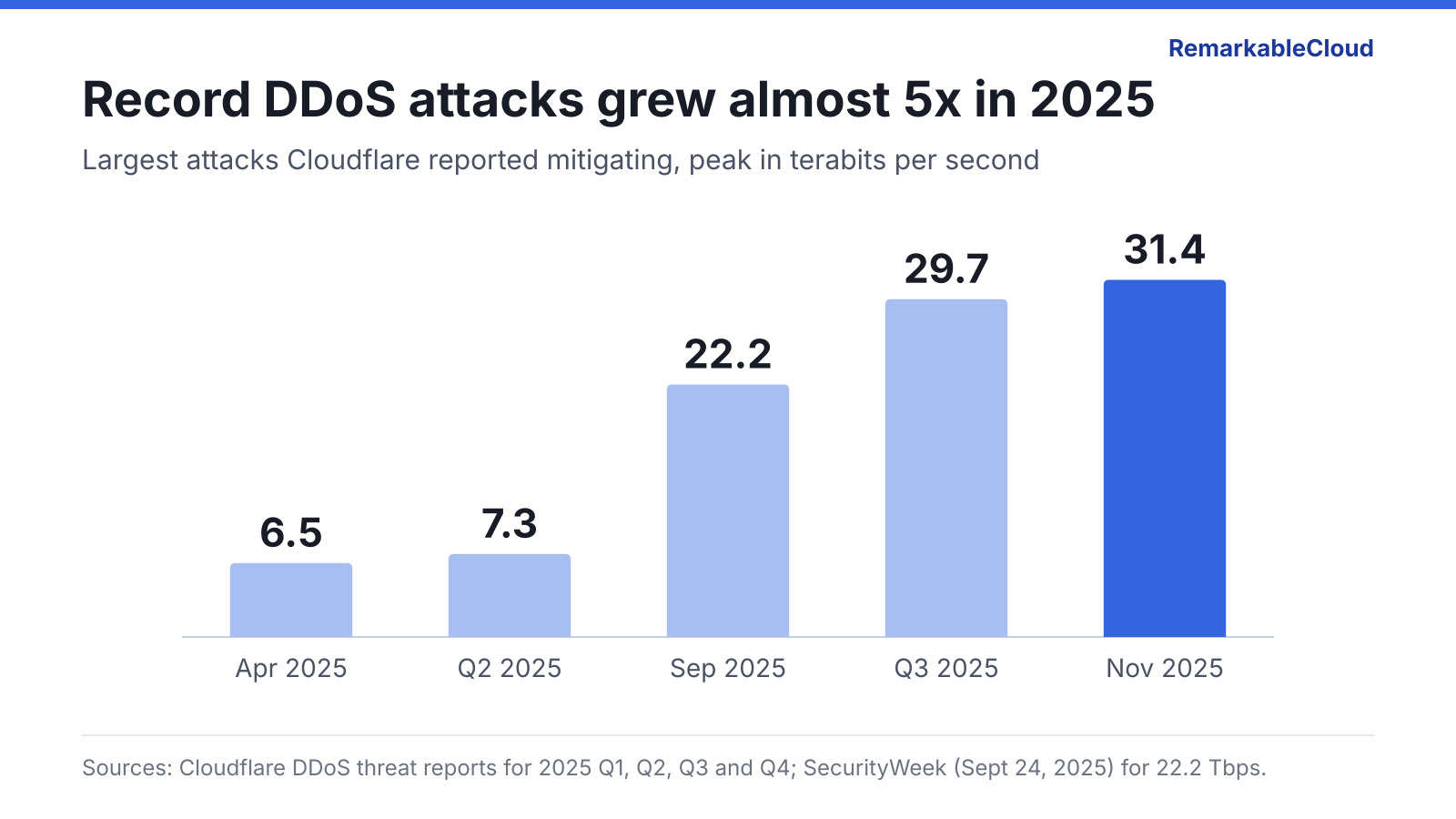
| When | Peak | Duration |
|---|---|---|
| Second half of April 2025 | 6.5 Tbps | 35 to 45 seconds |
| Q2 2025 | 7.3 Tbps | About 45 seconds |
| September 2025 | 22.2 Tbps | 40 seconds |
| Q3 2025 | 29.7 Tbps | Not stated |
| November 2025 | 31.4 Tbps | 35 seconds |
Record attacks now come from enormous botnets of hacked devices. Cloudflare attributed the November 2025 record to the Aisuru and Kimwolf botnets, and estimated Aisuru at 1 to 4 million infected hosts. Its Q3 2026 report says Aisuru and several other large botnets were dismantled during 2026, and neither its first-half nor its third-quarter 2026 report named a new record.
Notice the durations. Even the biggest attacks lasted well under a minute. They are bursts, not sieges.
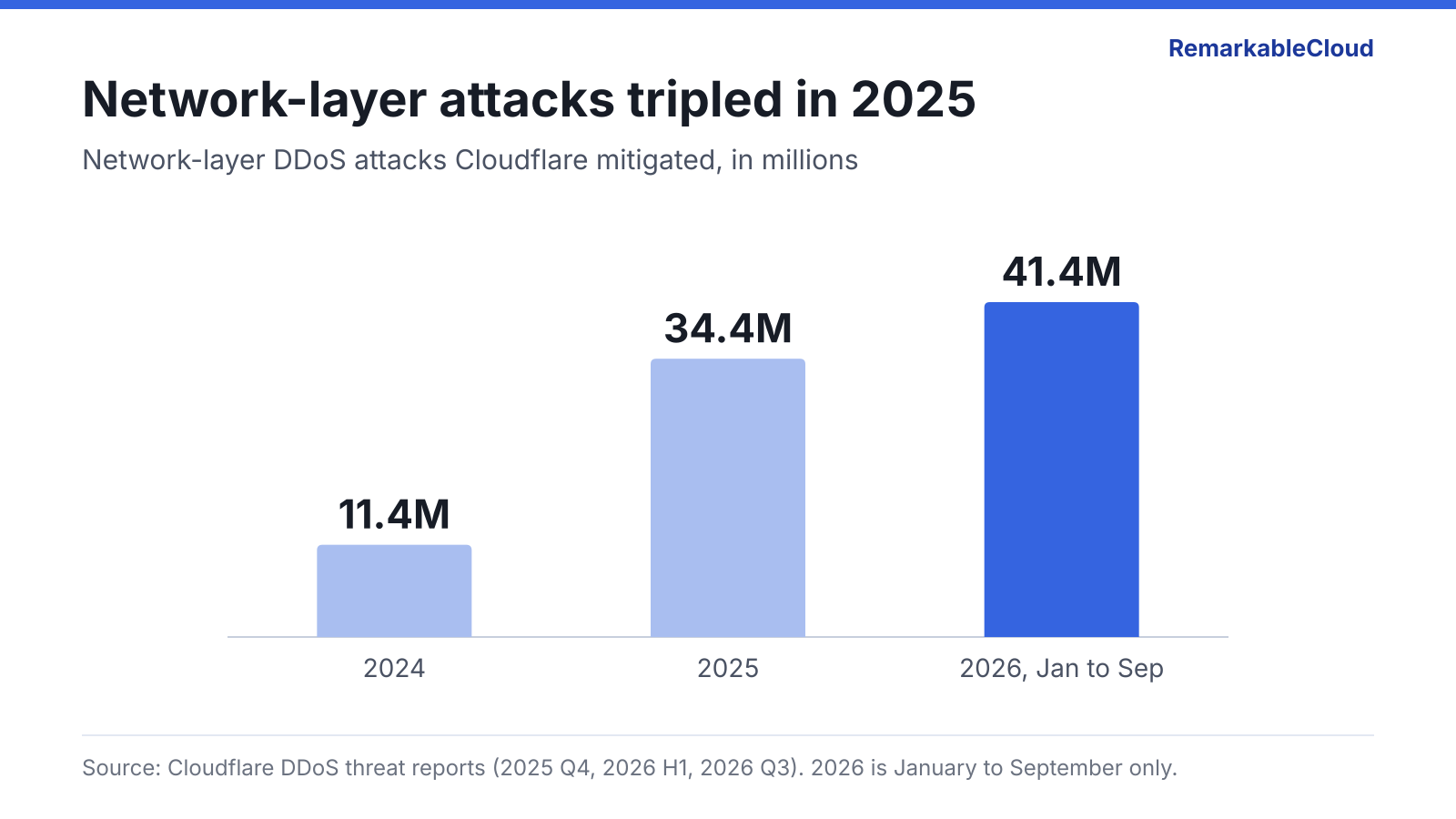
Network-layer attacks tripled in 2025
| Period | Network-layer attacks mitigated |
|---|---|
| 2024 | 11.4 million |
| 2025 | 34.4 million |
| January to June 2026 | 23.2 million |
| July to September 2026 | 18.2 million |
| January to September 2026 | 41.4 million |
Network-layer (layer 3 and 4) attacks flood a target with raw packets, such as UDP floods or SYN floods. Cloudflare mitigated 34.4 million of them in 2025, three times the 11.4 million of 2024, and 47.1 million DDoS attacks of all kinds. In the first nine months of 2026 it had already passed the 2025 network-layer total, and the third quarter alone was up 208% on the same quarter of 2025.
These counts come from one provider’s network and its own definitions, and Cloudflare changed how it reports HTTP attacks in 2026, so we compare network-layer counts only. Other providers see the same trend: NETSCOUT reported more than 8 million DDoS attacks in the first half of 2025 alone.
Most attacks are small and over in minutes
| Measure | Value |
|---|---|
| Attacks under 1 Gbps (Q3 2026) | 98% |
| Attacks that ended in under 10 minutes (Q3 2026) | 96% |
| Network-layer attacks under 500 Mbps (H1 2026) | 96.62% |
| Network-layer attacks over 1 Tbps (Q2 2025) | 5 in every 10,000 |
| Record peak (November 2025) | 31.4 Tbps |
The typical attack is small by internet standards. In the first half of 2026, 96.62% of network-layer attacks stayed under 500 megabits per second. Only about 5 in every 10,000 network-layer attacks in Q2 2025 exceeded 1 Tbps.
Small does not mean harmless. A single server’s network link is a tiny fraction of a global network’s capacity, and a website often falls over long before the link is full, because the CPU, the web server or the database runs out first. An attack that is tiny for a global network can take one site offline.
Over before anyone can react
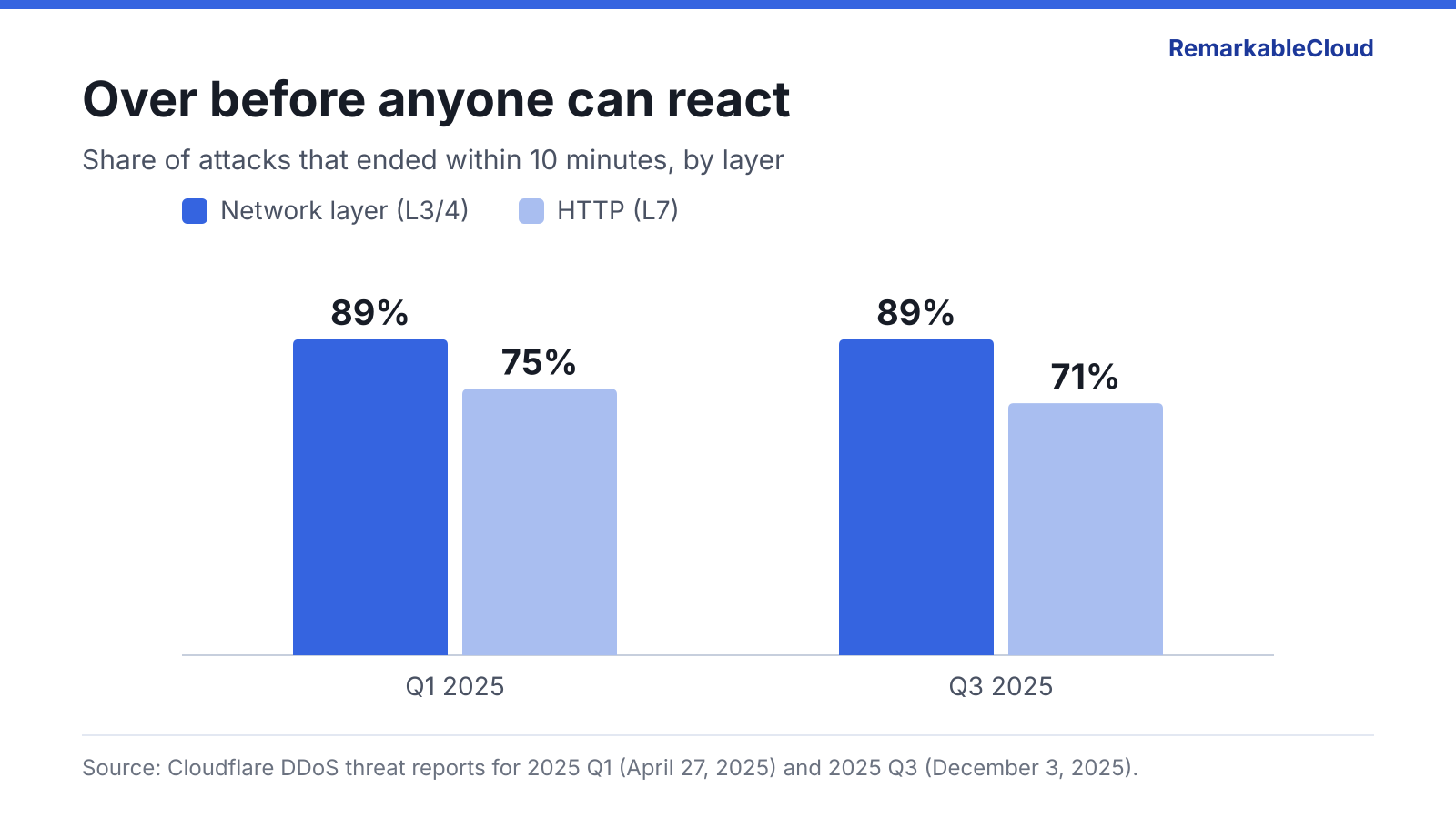
| Quarter | Network layer (L3/4) under 10 min | HTTP (L7) under 10 min |
|---|---|---|
| Q1 2025 | 89% | 75% |
| Q3 2025 | 89% | 71% |
| H1 2026 | 90.6% | Not published |
Nine in ten network-layer attacks end within 10 minutes. HTTP floods, which send what look like real page requests, tend to last a little longer. Either way, the attack is usually over before a person could read the alert, log in and start blocking addresses.
That is the core lesson of the duration data: DDoS protection has to be automatic and always on. If it depends on someone noticing, the site goes down for the length of the attack every time.
What protection actually covers
DDoS defense happens in layers, and each layer stops different things:
- Upstream network filtering (your hosting provider or a scrubbing network) absorbs floods of packets before they reach your server. Nothing on the server itself can help once the link is full, because the traffic never gets that far in a usable state.
- A CDN or web application firewall in front of the site handles HTTP floods, which look like legitimate requests, with rate rules and challenges.
- The server itself is the last layer. It can limit how many requests or connections one address gets, and survive SYN floods that slip through.
Ask your provider which layers are included, how large an attack the network filtering absorbs, and whether it is always on or must be switched on during an attack.
Server-side checks and limits
1. Check that SYN cookies are on. The Linux default is 1, which sends SYN cookies only when a socket’s queue overflows during a flood.
sysctl net.ipv4.tcp_syncookies2. See connection states during an incident. A large number of half-open connections (SYN-RECV) suggests a SYN flood.
ss -s
ss -Htan state syn-recv | wc -l
3. Find the addresses holding the most connections to your web server (IPv4 output shown).
ss -Htn state established '( sport = :443 )' | awk '{split($4,a,":"); print a[1]}' | sort | uniq -c | sort -rn | head4. Limit requests and connections per address in nginx. These directives come from the nginx documentation. The zones go in the http block, the limits in a server or location block.
limit_req_zone  $binary_remote_addr zone=perip:10m rate=10r/s;
limit_conn_zone $binary_remote_addr zone=connperip:10m;

server {
    limit_req  zone=perip burst=20 nodelay;
    limit_conn connperip 20;
    limit_req_status 429;
    limit_conn_status 429;
}
Tune the numbers to your real traffic first; a page that loads 40 assets over HTTP/2 counts each concurrent request as a separate connection for limit_conn.
5. Know your escalation path. Write down who to contact at your provider, and how, before you need it. A 10-minute attack does not leave time to look it up.
How this works on a RemarkableCloud server
Every server we sell is fully managed at no extra cost. The firewall and intrusion detection on each server are managed by us and fed by centralized log analysis and live threat data.
If an outage does happen, our 500% SLA applies from minute one: 1 hour down = 5 hours credited back. Automatically. If you want help tuning rate limits for your site, open a ticket and our team will go through it with you.
See how our managed VPS works, or read what a 99.9% uptime SLA actually pays you.
Methodology
- Cloudflare DDoS threat reports: 2025 Q1 (April 27, 2025), Q3 (December 3, 2025) and Q4 (February 5, 2026); 2026 H1 (August 11, 2026; Q1 and Q2 combined) and Q3 (October 29, 2026). Counts and shares are for attacks Cloudflare mitigated on its own network. Cloudflare sells DDoS protection.
- Records: 6.5 Tbps and 7.3 Tbps from Cloudflare’s 2025 Q1 and Q2 reports; 22.2 Tbps as reported by SecurityWeek on September 24, 2025; 29.7 Tbps from the 2025 Q3 report; 31.4 Tbps from the 2025 Q4 report (month per Security Affairs). Cloudflare also reported an 11.5 Tbps attack in 2025; we left it out because we could not confirm its date from a primary source.
- 2026 counts: the January to September figure adds the H1 2026 (23.2 million) and Q3 2026 (18.2 million) network-layer counts. Cloudflare’s 2026 reports count HTTP traffic as requests rather than attacks, so 2026 HTTP figures are not comparable with 2025 and are not used.
- Q3 2026 shares: the 98% and 96% figures are as stated in the Q3 2026 report, which does not say whether they cover the network layer only.
- NETSCOUT: press release of August 27, 2025 on its 1H 2025 threat report.
- Server settings: Linux kernel ip-sysctl documentation; nginx
limit_reqandlimit_conndocumentation.
Questions and answers
How big is the largest DDoS attack?
Cloudflare mitigated a 31.4 terabit per second attack in November 2025. It lasted 35 seconds.
How big is a typical DDoS attack?
Small. In the third quarter of 2026, 98% of the attacks Cloudflare saw stayed under 1 gigabit per second, and 96% were over in under 10 minutes. That is still enough to take a single server offline.
Can I stop a DDoS attack on my own server?
Not a large flood. Once the network link is full, nothing on the server can help, so packet floods must be filtered upstream. The server can still limit requests and connections per address and survive SYN floods that get through.
Why does DDoS protection need to be automatic?
Most attacks end within minutes, before anyone could read an alert and start blocking addresses. Protection that waits for a person means downtime for the length of every attack.
Sources and references
- Cloudflare DDoS report 2026 Q3 · blog.cloudflare.com
- Cloudflare DDoS report 2026 H1 · blog.cloudflare.com
- Cloudflare DDoS report 2025 Q4 · blog.cloudflare.com
- Cloudflare DDoS report 2025 Q3 · blog.cloudflare.com
- Cloudflare DDoS report 2025 Q2 · radar.cloudflare.com
- Cloudflare DDoS report 2025 Q1 · blog.cloudflare.com
- SecurityWeek on the 22.2 Tbps attack · securityweek.com
- Security Affairs on the 31.4 Tbps attack · securityaffairs.com
- NETSCOUT 1H 2025 · businesswire.com
- Linux ip-sysctl · docs.kernel.org
- nginx limit_req · nginx.org
- nginx limit_conn · nginx.org