
AI crawlers take a lot and send little back. What robots.txt can do
On this page
- What we measured on our own site
- Pages crawled for every visitor sent back across the web
- Most AI crawling is for training
- AI summaries cut clicks to websites
- Sites block training, not search
- What robots.txt can and cannot do
- What llms.txt is, and is not
- Check your logs, then set your rules
- How this works on a RemarkableCloud server
- Methodology
- Questions and answers
- Sources and references
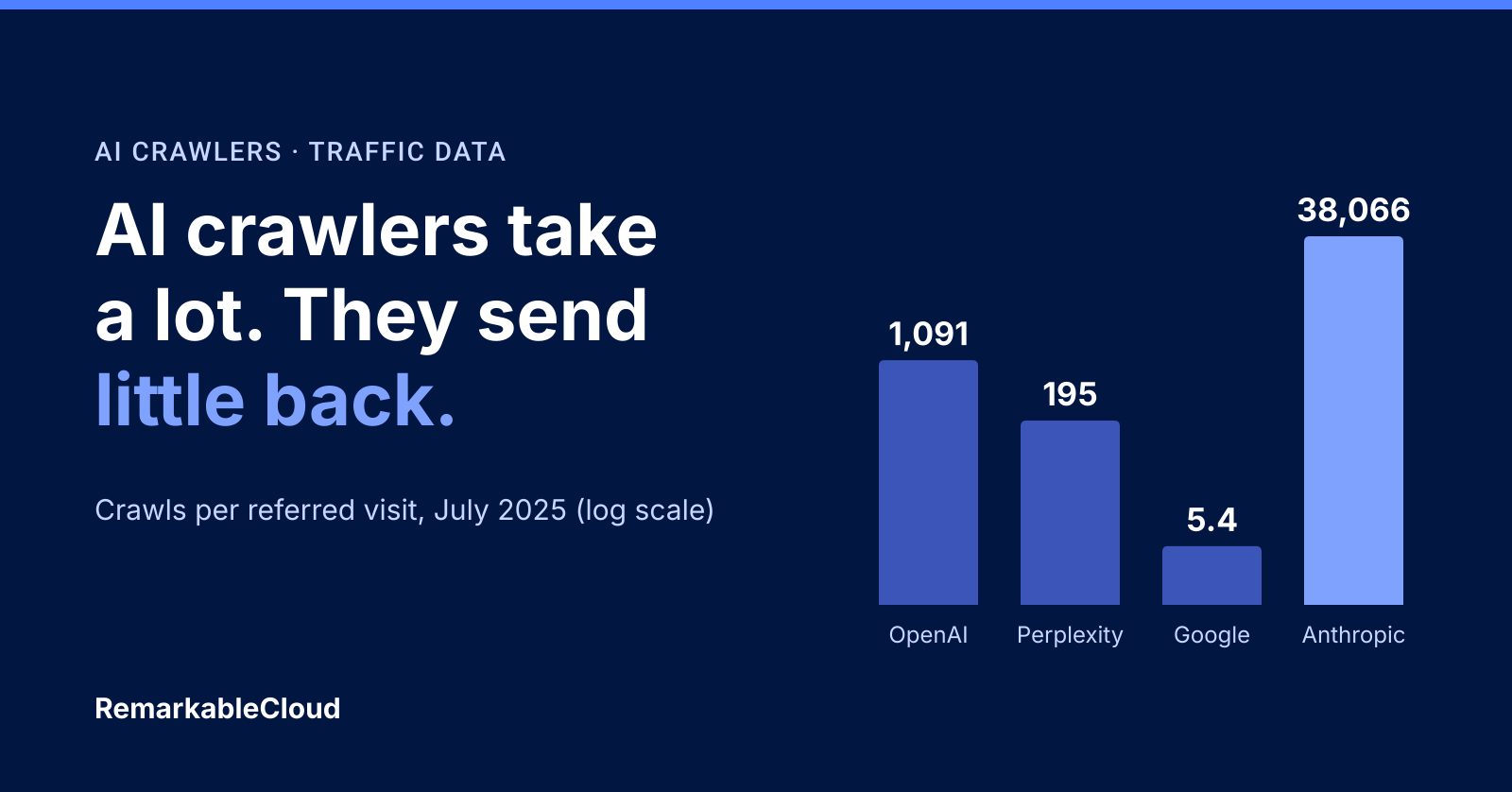
Search engines made a simple deal with websites: let us crawl you, and we will send you visitors. AI crawlers are changing the ratio. We measured it on our own site: in the 30 days to November 22, 2026, AI crawlers and assistants made 21,693 requests to remarkablecloud.com, and AI assistants sent us 36 visitors. That is about 600 requests for every visitor.
Our site is small, so we checked it against the largest dataset available. In July 2025, Cloudflare measured that Anthropic’s crawlers fetched about 38,000 pages for every visitor Anthropic’s products referred back. OpenAI’s ratio was about 1,100 to 1. Google’s was 5.4 to 1.
Most of that crawling is for training models, not for answering a question with a link to your page. Here is what our logs and the wider data show, what it means for a site you run, and what robots.txt, llms.txt and your access logs can and cannot do about it.
What we measured on our own site
We import the access logs of remarkablecloud.com into Matomo, which identifies AI crawlers and assistants by their user agent and counts visits referred by AI assistants separately. In the 30 days from October 24 to November 22, 2026, it recorded 20 different AI crawlers and assistants.
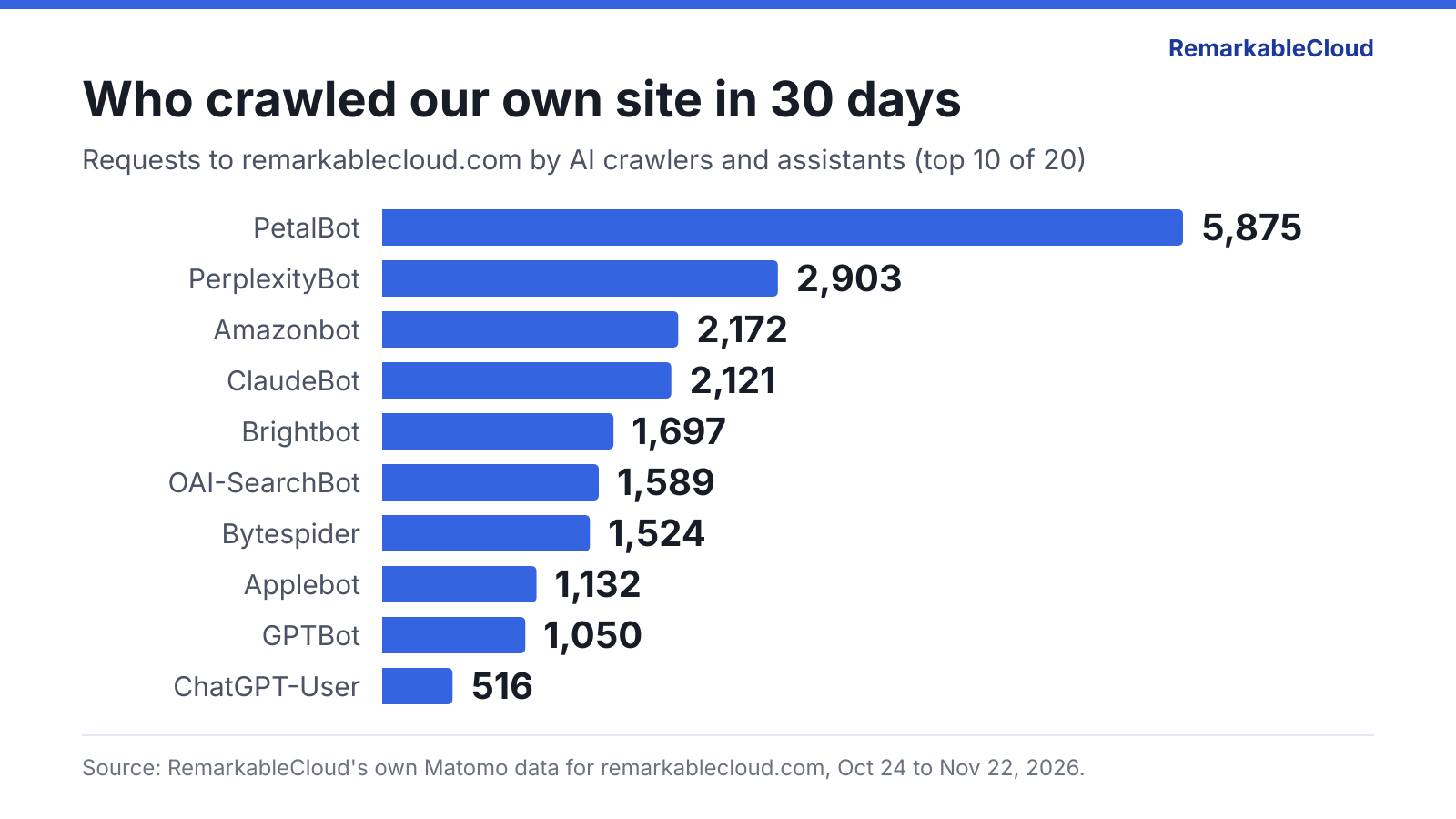
| Crawler | Requests, Oct 24 to Nov 22, 2026 |
|---|---|
| PetalBot (Huawei) | 5,875 |
| PerplexityBot | 2,903 |
| Amazonbot | 2,172 |
| ClaudeBot | 2,121 |
| Brightbot | 1,697 |
| OAI-SearchBot | 1,589 |
| Bytespider (ByteDance) | 1,524 |
| Applebot | 1,132 |
| GPTBot | 1,050 |
| ChatGPT-User | 516 |
| 10 others combined | 1,114 |
| Total | 21,693 |
Then we compared each company’s requests with the visits its assistant sent us in the same 30 days:
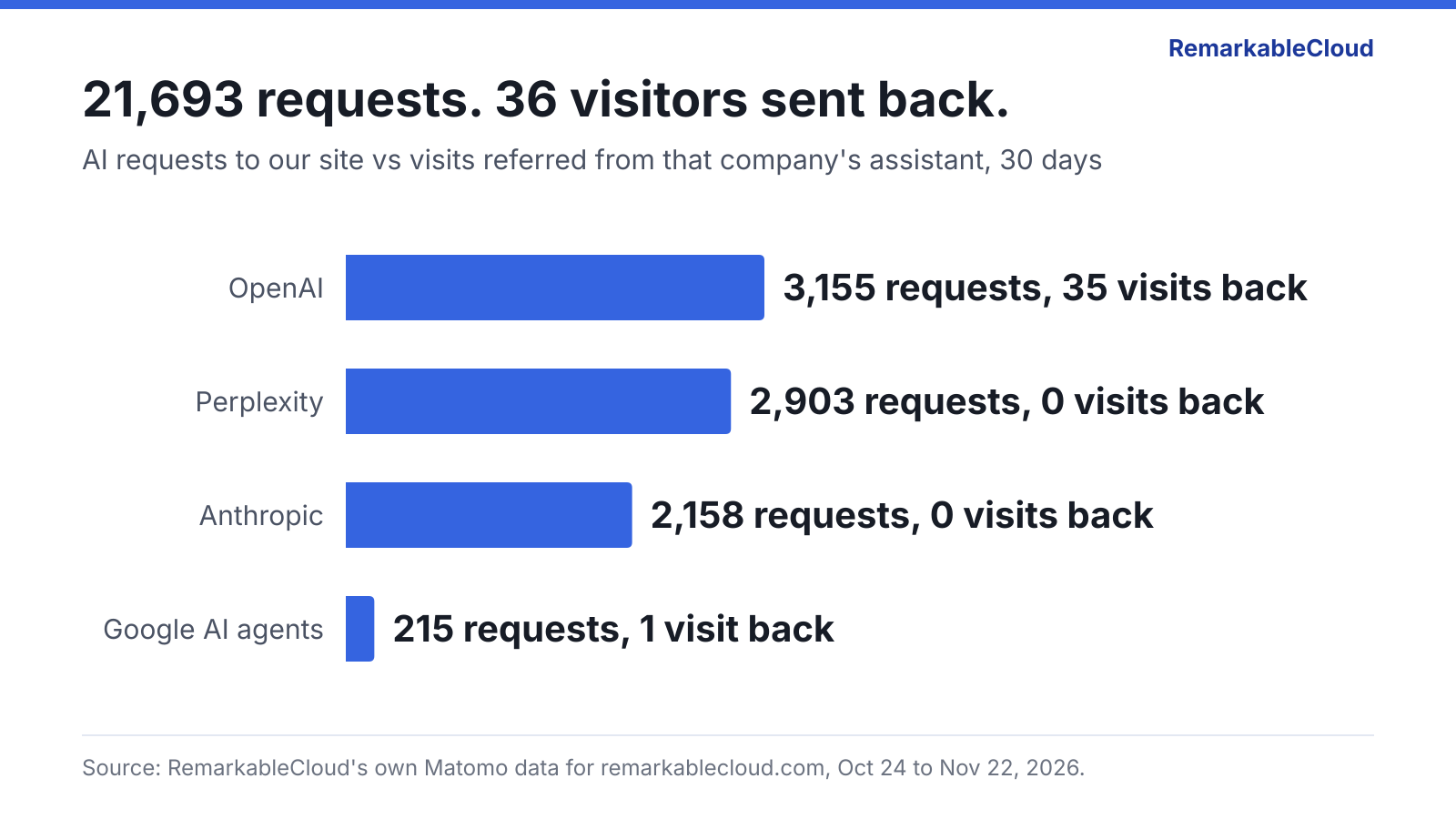
| Company | Requests (crawlers counted) | Visits referred back |
|---|---|---|
| OpenAI | 3,155 (OAI-SearchBot, GPTBot, ChatGPT-User) | 35 |
| Perplexity | 2,903 (PerplexityBot) | 0 |
| Anthropic | 2,158 (ClaudeBot, Claude-User) | 0 |
| Google AI agents | 215 (GoogleOther, NotebookLM, Gemini Deep Research) | 1 |
Three things stood out:
- Only ChatGPT sends visitors. 35 of the 36 AI-referred visits came from ChatGPT, about one visit for every 90 OpenAI requests. Perplexity and Anthropic crawled thousands of pages and sent no one.
- The few visitors are good ones. Visitors from AI assistants spent 7 minutes on the site on average and 25% left after one page. Visitors from search engines stayed about 3 minutes and 68% left after one page.
- Crawlers still ask for pages that no longer exist. 946 requests (4.4%) hit a 404, mostly WordPress-era addresses like
/post-sitemap.xmland/feed/from before we moved the site to a static build. Crawlers keep old URLs for months, so redirects matter for them too.
Pages crawled for every visitor sent back across the web
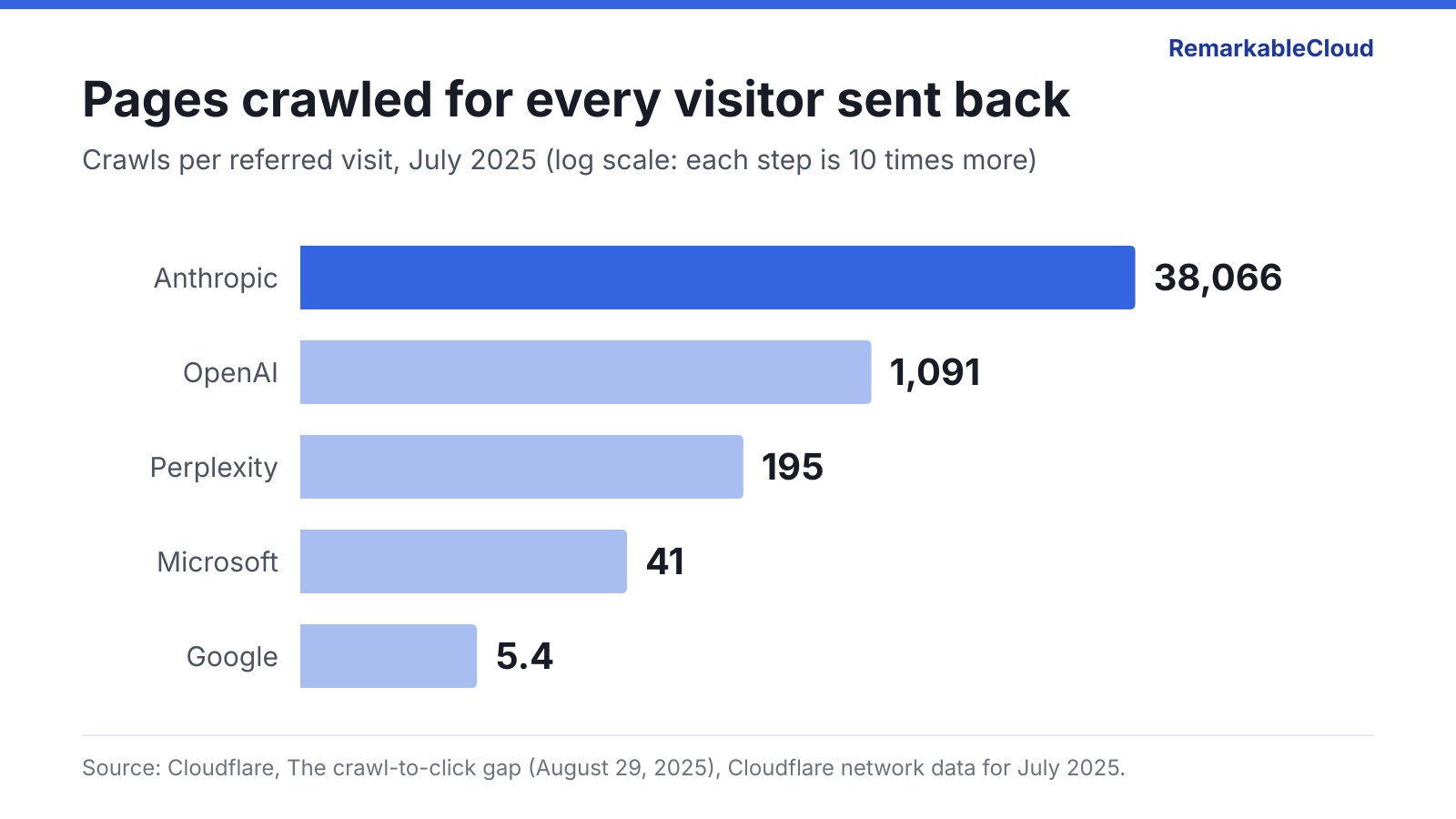
| Company | Crawls per referred visit, January 2025 | July 2025 |
|---|---|---|
| Anthropic | 286,930 | 38,066 |
| OpenAI | 1,217 | 1,091 |
| Perplexity | 55 | 195 |
| Microsoft | 39 | 41 |
| 3.8 | 5.4 |
Cloudflare sees a large share of web traffic, so it can compare how often each company’s crawlers fetch pages with how often people arrive from that company’s products. The chart uses a log scale, because the gap between Google and Anthropic is too wide to show otherwise.
The ratios move. Anthropic’s fell sharply between January and July 2025, while Perplexity’s rose. Cloudflare’s 2025 Year in Review put Anthropic’s ratio at as much as 500,000 to 1 early in the year and between about 25,000 and 100,000 to 1 later, and Google’s at just over 3 to 1. Whatever the exact month, the order of magnitude is the point: for most AI companies, a crawl is not a visit you get back.
Most AI crawling is for training
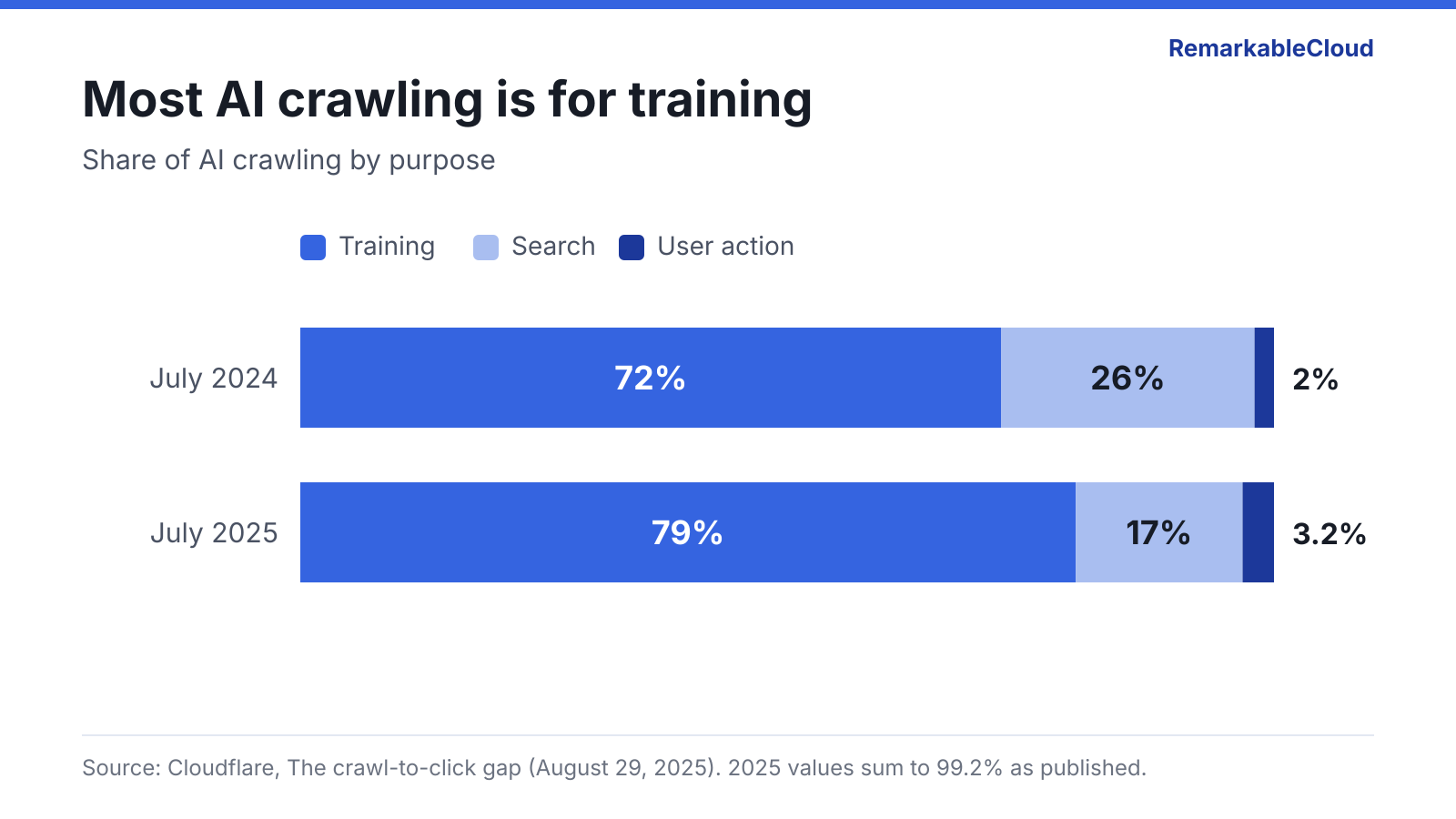
| Purpose | July 2024 | July 2025 |
|---|---|---|
| Training | 72% | 79% |
| Search | 26% | 17% |
| User action | 2% | 3.2% |
Cloudflare splits AI crawling into three purposes. Training crawlers collect pages to build or improve models. Search crawlers index pages so an AI assistant can cite them in answers. User-action fetches happen when someone asks an assistant to read a specific page. Only the last two can send anyone back to you, and together they were about a fifth of AI crawling in July 2025.
The shift is visible across all crawling too. Cloudflare reported in September 2026 that 22% of all crawler requests it saw in spring 2025 were for AI training, and 52% by June 2026.
The individual crawlers changed places as well. GPTBot’s share of AI-only crawler traffic went from 5% in May 2024 to 30% in May 2025, while ByteDance’s Bytespider fell from 42% to 7%.
AI summaries cut clicks to websites
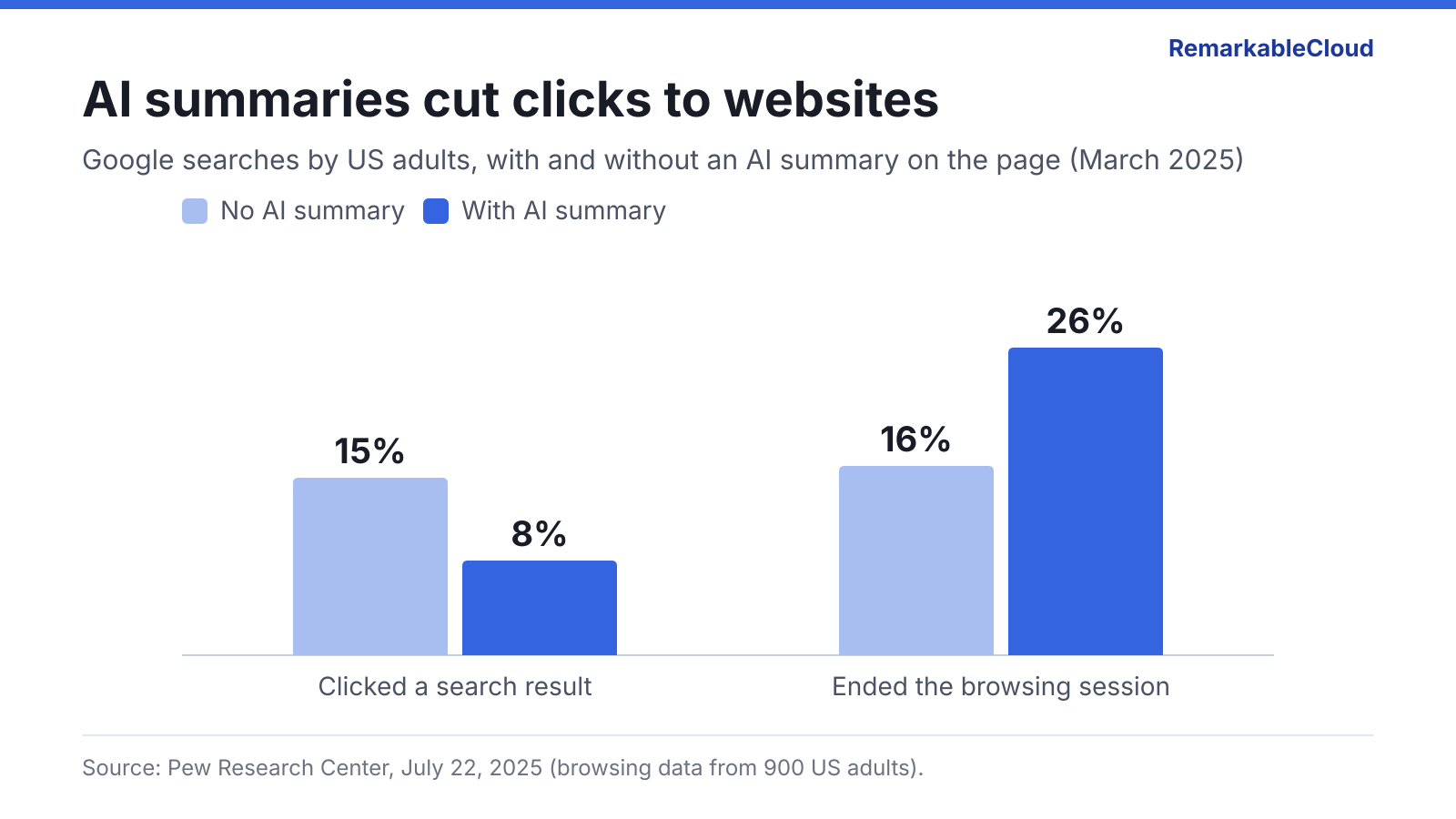
| Behavior on a Google search page | No AI summary | With AI summary |
|---|---|---|
| Clicked a traditional search result | 15% | 8% |
| Ended the browsing session | 16% | 26% |
| Clicked a link inside the summary | 1% |
The referral problem is not limited to AI companies’ own apps. Pew Research Center tracked the actual browsing of 900 US adults in March 2025. When Google showed an AI summary, people clicked a regular search result in 8% of visits, against 15% when there was no summary. Only 1% of visits included a click on a link inside the summary itself, and people were more likely to end their browsing session right there.
Industry studies point the same way. Ahrefs measured in February 2026 that AI Overviews reduce the click-through rate of the top-ranking result by 58% across 300,000 keywords. Seer Interactive found organic click-through of 0.61% on queries with an AI Overview in September 2025, against 1.62% on queries without one.
Sites block training, not search
| Measure (sites on Cloudflare) | Value |
|---|---|
| Sites that block AI training crawlers | 17% |
| Sites that block search crawlers | Fewer than 1% |
| Crawler requests for AI training, June 2026 | 52% |
Site owners have started to choose. On Cloudflare, 17% of sites block training crawlers and fewer than 1% block search crawlers. In July 2025, Cloudflare made blocking AI crawlers its default. Its 2025 Year in Review found that the user agents with the most full “Disallow” rules in robots.txt files are AI crawlers: GPTBot, ClaudeBot and CCBot.
That split is a sensible default for most businesses. Blocking training crawlers costs you little, because they rarely send visitors. Blocking search crawlers, including AI search, removes you from places where people now look for answers.
What robots.txt can and cannot do
The major AI companies publish separate user agents for training, search and user-requested fetches, so you can treat them differently:
| Company | Training | Search | User-requested fetch |
|---|---|---|---|
| OpenAI | GPTBot | OAI-SearchBot | ChatGPT-User |
| Anthropic | ClaudeBot | Claude-SearchBot | Claude-User |
| Google-Extended (a robots.txt token only) | Googlebot | ||
| Perplexity | PerplexityBot | Perplexity-User | |
| Common Crawl | CCBot |
Three limits to know:
- robots.txt is a request, not a lock. Well-behaved crawlers follow it. OpenAI says robots.txt rules “may not apply” to ChatGPT-User, and Perplexity says Perplexity-User “generally ignores robots.txt rules”, because both act on a person’s request. In August 2025, Cloudflare reported that Perplexity also crawled sites that had blocked it, using a generic browser user agent.
- Google-Extended never shows up in your logs. Google says it “doesn’t have a separate HTTP request user agent string”. Blocking it tells Google not to use your content for Gemini training and grounding, and Google says it “does not impact a site’s inclusion in Google Search”.
- Blocking by IP can backfire. Anthropic notes that if you block its IP addresses, its crawler can’t read your robots.txt to see what you want.
What llms.txt is, and is not
llms.txt is a proposal, first published in September 2024, for a Markdown file at the root of your site that summarizes the site and links to its most useful pages for language models. It is not an access control file: its own specification says robots.txt and llms.txt “have different purposes”.
Google says Google Search does not use llms.txt and that it will “neither harm nor help” your site in Search. We did not find any official statement from OpenAI, Anthropic or Perplexity that their crawlers read it. It takes minutes to publish, and some developer documentation sites use it, but it does not control crawling and there is no public evidence that it brings traffic.
Check your logs, then set your rules
1. Count hits per AI crawler. On nginx the log is usually /var/log/nginx/access.log; on Apache, /var/log/apache2/access.log (Debian, Ubuntu) or /var/log/httpd/access_log (RHEL family).
grep -oiE 'GPTBot|OAI-SearchBot|ChatGPT-User|ClaudeBot|Claude-User|Claude-SearchBot|PerplexityBot|Perplexity-User|CCBot|Bytespider|Meta-ExternalAgent|Amazonbot' /var/log/nginx/access.log | sort | uniq -c | sort -rn2. See which pages one crawler fetches most.
grep 'GPTBot' /var/log/nginx/access.log | awk '{print $7}' | sort | uniq -c | sort -rn | head -203. Measure the bandwidth they use. In the default combined log format, field 10 is the response size in bytes.
grep -iE 'GPTBot|ClaudeBot|CCBot|Bytespider' /var/log/nginx/access.log | awk '{s+=$10} END {print s/1048576 " MB"}'4. Count visits that came from AI assistants, to compare with the crawling.
grep -ciE 'chatgpt\.com|perplexity\.ai|claude\.ai' /var/log/nginx/access.log5. Write your rules. This robots.txt blocks the main training crawlers and keeps AI search crawlers allowed:
User-agent: GPTBot
Disallow: /

User-agent: ClaudeBot
Disallow: /

User-agent: CCBot
Disallow: /

User-agent: Google-Extended
Disallow: /

User-agent: OAI-SearchBot
Allow: /

User-agent: Claude-SearchBot
Allow: /

User-agent: PerplexityBot
Allow: /
If a crawler is simply too busy rather than unwelcome, Anthropic’s crawlers honor Crawl-delay in robots.txt.
6. Find what crawlers ask for that no longer exists. Old URLs from a previous CMS are common. Redirect the ones that have a new home.
grep -iE 'GPTBot|ClaudeBot|PerplexityBot|OAI-SearchBot|Amazonbot|Bytespider' /var/log/nginx/access.log | awk '$9 == 404 {print $7}' | sort | uniq -c | sort -rn | head -207. Check again in a week. Run step 1 again. Crawlers that follow robots.txt drop off. Anything still hitting blocked paths heavily is a candidate for a rate limit or a firewall rule.
How this works on a RemarkableCloud server
Every server we sell is fully managed at no extra cost. The firewall and intrusion detection on each server are managed by us and fed by centralized log analysis and live threat data.
What you allow AI companies to crawl is a business decision, so the robots.txt is yours. If crawler traffic is loading your server, or you want help reading your access logs, open a ticket and our team will go through it with you. We publish an llms.txt for our own site because it costs nothing, not because we expect it to send visitors.
See how our managed VPS works.
Methodology
- Our own data: RemarkableCloud’s Matomo, from the access logs of remarkablecloud.com, October 24 to November 22, 2026 (30 days). AI crawlers and assistants are identified by user agent through Matomo’s bot tracking; a request is one logged page or file request by such a crawler. Visits referred by AI assistants come from our JavaScript tracker, which recognizes referrers such as chatgpt.com and gemini.google.com. It cannot see visitors who block JavaScript, and an assistant that does not send a referrer looks like a direct visit, so referrals may be undercounted. One site over one month: treat it as an example, not a benchmark.
- Crawl-to-referral ratios and crawl purpose: Cloudflare, “The crawl-to-click gap” (August 29, 2025), from Cloudflare network data, January to July 2025. A referral is a visit to a site with a Referer header from the AI company’s product. Ratios for July 2025 are rounded to whole numbers in the chart (Google: 5.4). The 2025 purpose shares sum to 99.2% as published.
- Year in Review: Cloudflare Radar 2025 Year in Review (December 15, 2025), data January 1 to December 2, 2025.
- Blocking and training share: Cloudflare, “The Internet has a second audience” (September 30, 2026). The 22% and 52% training shares are of all crawler requests, a different base from the AI-only purpose shares above. Cloudflare’s numbers cover sites and traffic on its network.
- Crawler shares: Cloudflare, “From Googlebot to GPTBot” (July 1, 2025), May 2024 to May 2025.
- Clicks: Pew Research Center (July 22, 2025), browsing data of 900 US adults collected in March 2025. Ahrefs (February 4, 2026), 300,000 keywords. Seer Interactive (November 4, 2025), 3,119 queries across 42 organizations. Ahrefs and Seer are commercial SEO companies.
- User agents and robots.txt behavior: each company’s own crawler documentation, checked November 22, 2026. Perplexity crawling report: Cloudflare (August 4, 2025).
- llms.txt: llmstxt.org and Google’s AI optimization guide (updated July 10, 2026).
Questions and answers
How much do AI crawlers send back to websites?
Very little. On remarkablecloud.com, AI crawlers and assistants made 21,693 requests in 30 days, and AI assistants sent 36 visitors, about 600 requests per visit.
Which AI assistant sends the most visitors?
On our site, ChatGPT: it sent 35 of the 36 AI-referred visits, about one for every 90 OpenAI requests. Perplexity and Anthropic crawled thousands of pages and sent no visitors.
What is the crawl-to-referral ratio for each AI company?
In Cloudflare's July 2025 measurement, Anthropic fetched about 38,000 pages for every visitor it referred, OpenAI about 1,100 and Google 5.4. The ratios change month to month, but the order of magnitude stays.
Why do AI crawlers send so little traffic back?
Most AI crawling is for training models. In July 2025, search crawling and user-requested fetches, the only kinds that can send visitors back, were about a fifth of AI crawling.
Do AI summaries in Google reduce clicks?
Yes. In Pew Research Center's browsing data, people clicked a regular search result in 8% of visits with an AI summary, against 15% without one. Only 1% clicked a link inside the summary.
Sources and references
- Cloudflare, The crawl-to-click gap · blog.cloudflare.com
- Cloudflare Radar 2025 Year in Review · blog.cloudflare.com
- Cloudflare, The Internet has a second audience · blog.cloudflare.com
- Cloudflare, From Googlebot to GPTBot · blog.cloudflare.com
- Cloudflare, Content Independence Day · blog.cloudflare.com
- Cloudflare on Perplexity's undeclared crawlers · blog.cloudflare.com
- Pew Research Center · pewresearch.org
- Ahrefs · ahrefs.com
- Seer Interactive · seerinteractive.com
- OpenAI crawlers · developers.openai.com
- Anthropic crawlers · support.claude.com
- Google common crawlers · developers.google.com
- Perplexity crawlers · docs.perplexity.ai
- Common Crawl CCBot · commoncrawl.org
- llms.txt proposal · llmstxt.org
- Google AI optimization guide · developers.google.com