
Attackers exploit flaws in days. Who patches your server?
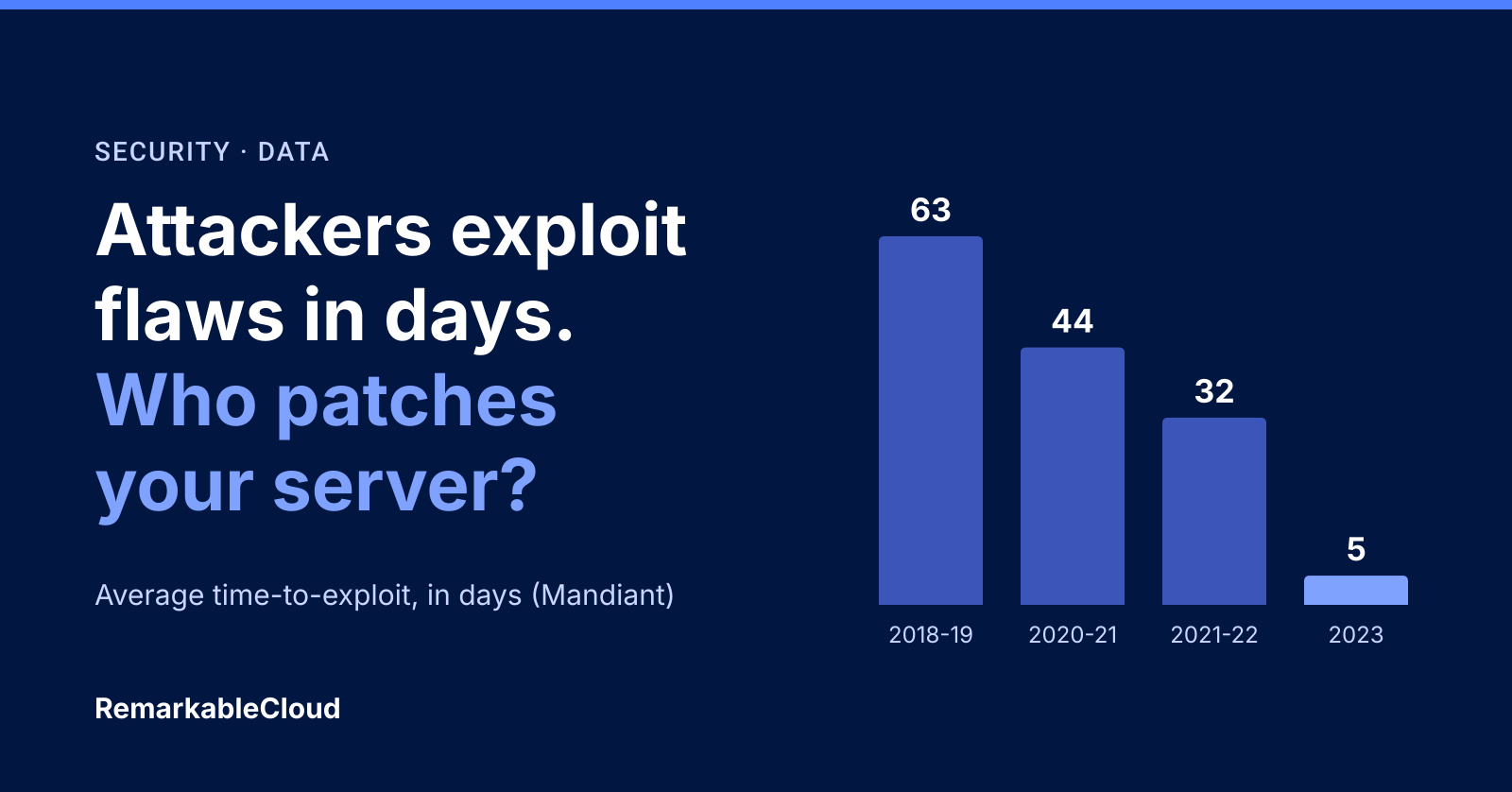
In 2018 the average vulnerability gave you about two months between the fix and the first attack. In 2023 it gave you five days. In 2026, exploiting a known flaw became the most common way a breach starts, and the people fixing those flaws got slower, not faster.
None of this is new to security teams. It is new to most people who run a website, a store or a client’s server on a VPS, because the numbers live in reports written for CISOs. This article pulls the numbers out of four of those reports, explains how each one was measured, and ends with what to do about it, whoever manages your server.
The window between patch and attack closed
Mandiant, Google’s incident response unit, tracks how long it takes attackers to exploit a vulnerability, measured from the day a patch is released. They call it time-to-exploit. Zero-days are exploited before the patch exists; n-days are exploited after it ships.
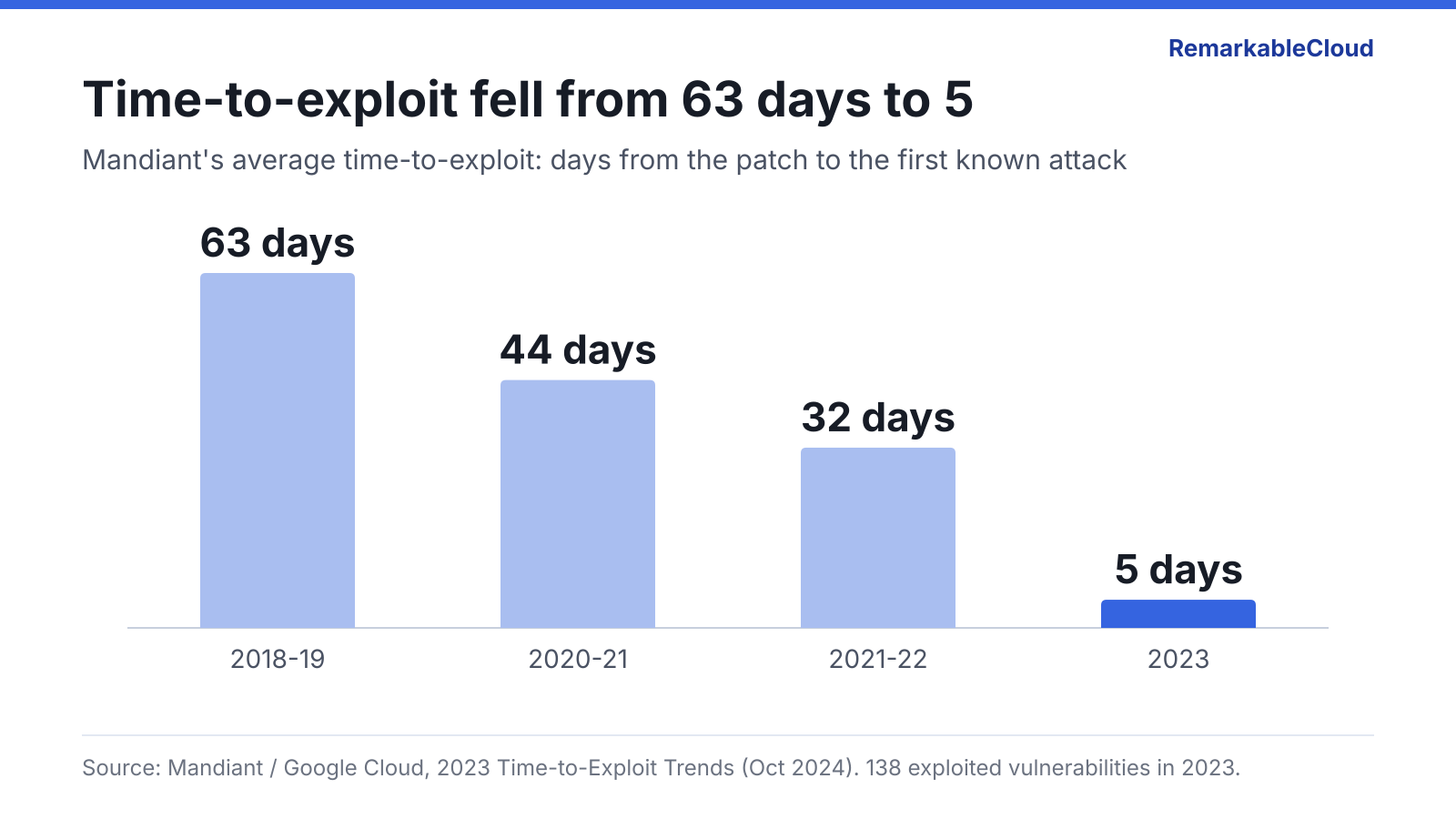
| Period | Average time-to-exploit |
|---|---|
| 2018 to 2019 | 63 days |
| 2020 to early 2021 | 44 days |
| 2021 to 2022 | 32 days |
| 2023 | 5 days |
The 2023 figure comes from 138 vulnerabilities that were exploited in the wild that year: 97 zero-days and 41 n-days (flaws first exploited after a patch was available). Two details matter for reading it honestly:
- The average excludes 15 outliers. With them, the 2023 average is 47 days, not 5. A handful of very old flaws exploited years later pull the mean up a lot. The five-day figure describes the typical case better; the 47-day figure tells you old flaws never fully stop being a risk.
- It is a conservative number. Mandiant uses the first reported exploitation date, and when a report is vague (“mid-July”), it assumes the latest plausible date. Attacks nobody detected are not in the data. The real number is almost certainly shorter.
Even with a patch out, a week is a long time
The zero-days are the scary headline, but they are not what usually hurts a small business. The more common story is a flaw that already had a fix, on a server nobody updated in time. Mandiant’s n-day data shows how quickly that window gets used.
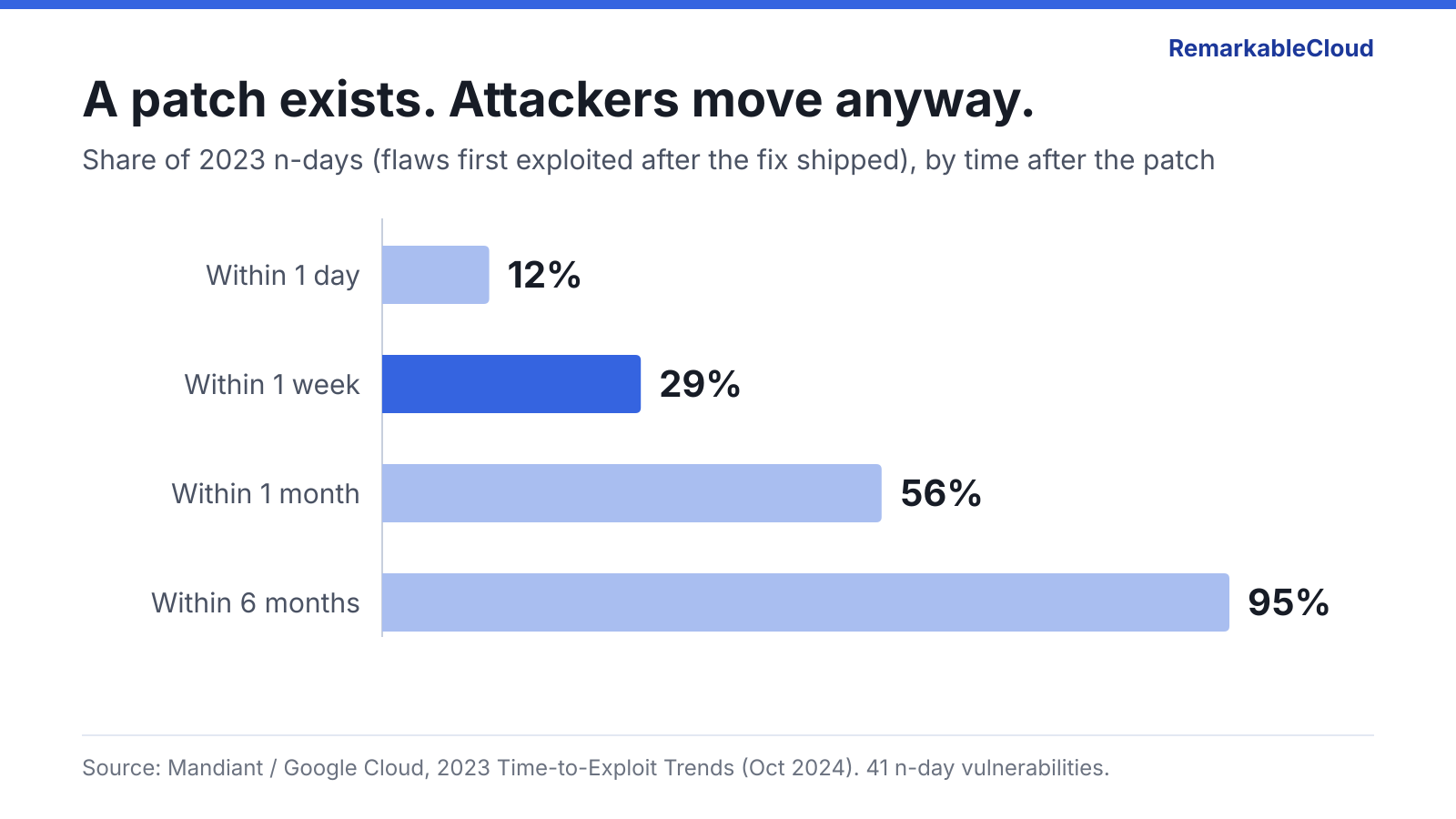
Of the 41 n-days in 2023, 12% were exploited within a day of the patch, 29% within a week and 56% within a month. All but two were exploited within six months. If your patching cycle is “when someone gets to it”, most of these flaws had attackers on them before the server was updated.
More breaches start with a flaw, and fixes take longer
Verizon’s Data Breach Investigations Report is the largest public dataset of real breaches. The 2026 edition, built on more than 22,000 breaches across 145 countries, crossed a line the report had never crossed in its 19 years: exploiting a vulnerability became the most common way attackers got in, ahead of stolen credentials.
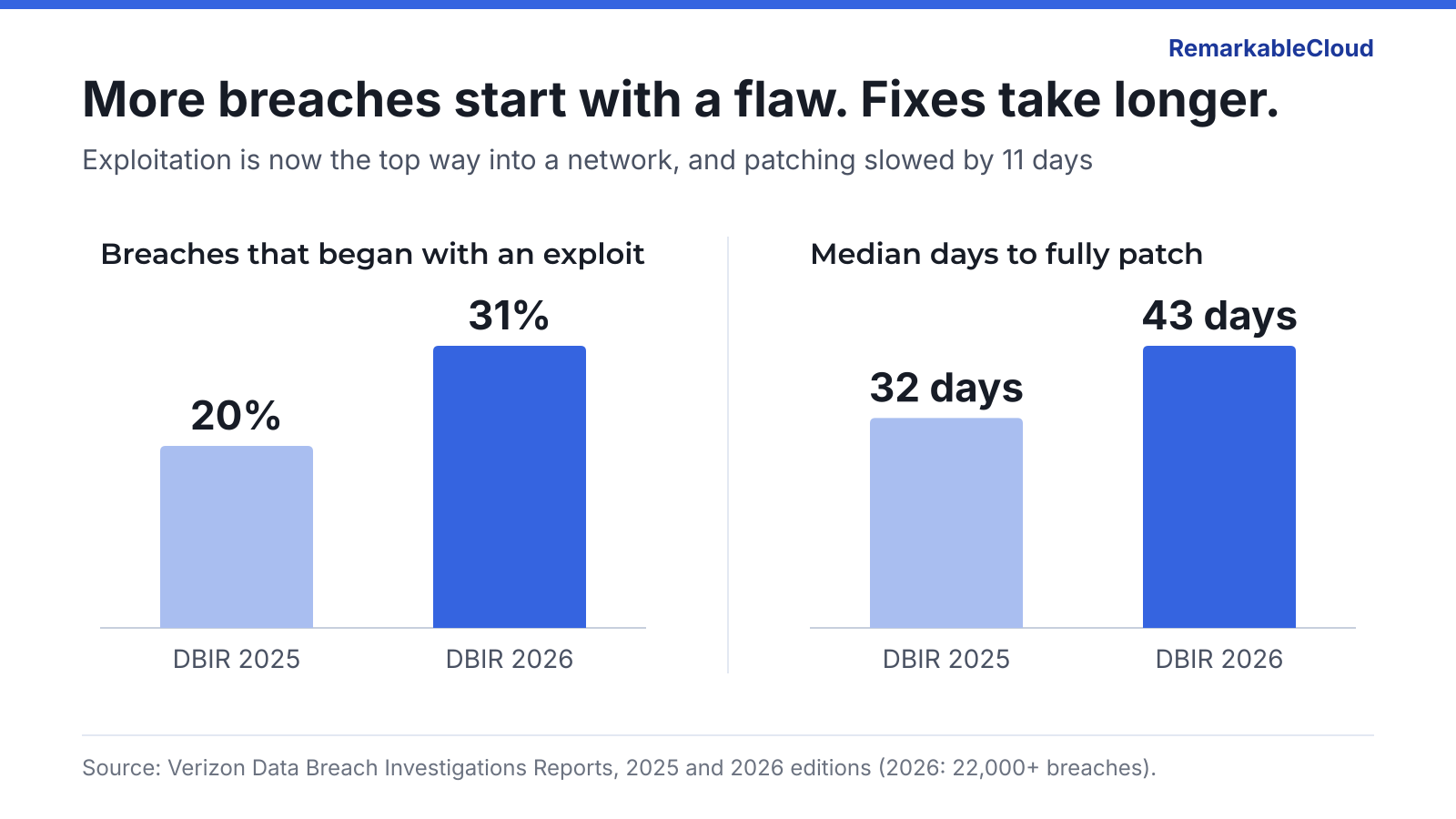
| Verizon DBIR | 2025 report | 2026 report |
|---|---|---|
| Breaches where exploitation was the way in | 20% | 31% |
| Median days to fully patch | 32 days | 43 days |
| CISA known exploited flaws fully fixed | 38% | 26% |
Put the two reports side by side and the problem is plain. Attackers typically need days. The organizations in Verizon’s data needed a median of 43 days to fully patch, and fully fixed only about a quarter of the flaws the US government lists as actively exploited.
And the volume just doubled
Patching would be easier if there were fewer things to patch. The opposite is happening.
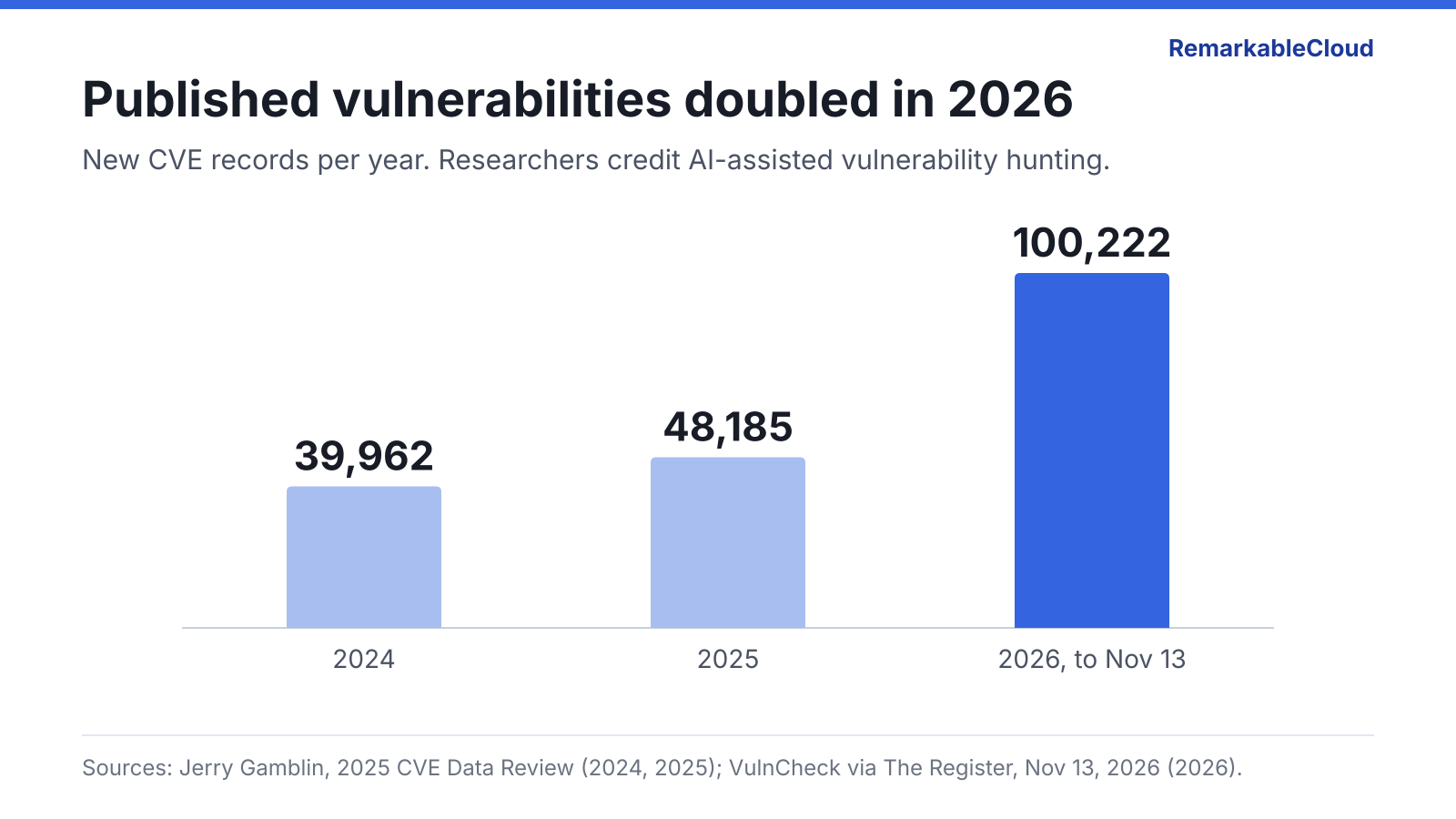
A CVE is a public ID for a disclosed vulnerability. 2025 set a record with 48,185 of them, and a big share came from WordPress plugins: Patchstack and Wordfence, two WordPress security firms, reported over 10,000 between them. On November 13, 2026, VulnCheck counted 100,222 CVEs published so far this year, more than double 2025. VulnCheck’s own researchers attribute most of the jump to AI-assisted vulnerability hunting.
The useful part: only about 1.4% of 2026 CVEs (1,363) are on VulnCheck’s list of flaws known to be exploited, and that share has stayed steady as the total grew. Nobody can patch 100,000 things by hand. You do not have to. You have to find the 1 to 2% that attackers actually use, on the software you actually run, and fix those in hours, not weeks.
What this means for a server you depend on
If you run a VPS for your business or your clients, the data turns into four questions about whoever looks after it, whether that is you, a freelancer or your host:
- Who reads the advisories? Someone has to see the vendor notice the day it is published, for the OS, the control panel, the web server, PHP, the database and every app installed on the box.
- How fast does a fix reach your server? The difference between hours and 43 days is the difference between the 12% and the 56% in the chart above.
- What happens when there is no patch yet? Zero-days and slow vendors are real. Firewall rules, disabling the affected feature and watching the logs close the gap until a fix ships.
- Can you roll back? Updates occasionally break things. A snapshot from before the update is what makes fast patching safe instead of reckless.
A checklist you can use today
These apply to any Linux server, managed or not.
Turn on automatic security updates. On Ubuntu and Debian:
sudo apt install unattended-upgrades
sudo dpkg-reconfigure --priority=low unattended-upgrades
On AlmaLinux and other RHEL-based systems, install dnf-automatic, set upgrade_type = security in /etc/dnf/automatic.conf, then enable the timer:
sudo dnf install dnf-automatic
sudo systemctl enable --now dnf-automatic-install.timer
Kernel and core library updates only take effect after a reboot or a service restart, so schedule a reboot window or use a live-patching service.
Watch the list that matters. Subscribe to the security advisories of every vendor whose software runs on the server, and check the CISA Known Exploited Vulnerabilities catalog. If something you run shows up there, it goes to the top of the queue.
Shrink what is exposed. Close control panel ports and SSH to everyone except the IPs that need them. Remove plugins, themes and apps you no longer use; each one is code that can need a patch.
Keep a restore point. Take a snapshot before major updates and know how long a restore takes before you need one.
Measure yourself. Next time a critical advisory lands for software you run, write down the hours until it was patched. Compare that number with the charts above.
How we handle it at RemarkableCloud
Every server we sell is fully managed at no extra cost, and patching is part of that, not an add-on. This is how a vulnerability moves through our process:
- Detect. Our agents watch for newly reported vulnerabilities in the OS, the control panels and the apps we install on your server.
- Measure exposure. For each one, they check which servers in our fleet actually run the affected software and version, so we know exactly who is at risk, not just that a CVE exists.
- Protect before the patch. Where a server is exposed, we apply preventive measures right away: firewall rules, disabling the affected feature, or the vendor’s mitigation. Each server also sits behind a managed firewall and intrusion detection system fed by centralized log analysis and live threat data.
- Watch for the fix. We monitor vendor releases, so the patch is picked up the moment it ships.
- Test, then deploy. The patch goes to a dev box and canary servers first. Once it passes there, it rolls out to every affected server.
Rollback is built in too: every server gets an automatic daily snapshot, and you can create another one any time at no cost.
Steps 3 to 5 are what close the gap the charts above describe: protection starts with the advisory, not with the patch. A real example: on April 28, 2026, cPanel disclosed an authentication bypass in every supported version, with no patch available yet. We applied both of the vendor’s mitigations across every cPanel server we manage within minutes of the advisory, before a patch existed. Customers did not have to open a ticket or run a command. The full timeline is here.
If you would rather spend your hours on your business than on advisories, see what a fully managed VPS includes.
Methodology and sources
Each figure in this article comes from the source listed for it. Where sources measure different things, we say so.
- Time-to-exploit (Mandiant): “How Low Can You Go? An Analysis of 2023 Time-to-Exploit Trends”, Mandiant / Google Cloud, October 15, 2024. 138 vulnerabilities disclosed in 2023 and exploited in the wild (97 zero-days, 41 n-days). Average time-to-exploit, measured from patch release, with 15 statistical outliers removed (47 days with them). Earlier periods from the same series. Based on first reported exploitation, so conservative.
- Breach entry points and patch times (Verizon): 2026 Data Breach Investigations Report (more than 22,000 breaches, data from roughly the 12 months to late 2025) and the 2025 DBIR. The 43-day and 32-day medians are Verizon’s own year-over-year comparison of time to full remediation; the 26% and 38% figures are the share of CISA Known Exploited Vulnerabilities fully remediated in Verizon’s data.
- CVE volume: 2024 and 2025 totals from Jerry Gamblin’s 2025 CVE Data Review (excludes rejected CVEs). The 2026 count is VulnCheck’s, as reported by The Register on November 13, 2026, together with the 1.4% exploited share. Different trackers count slightly differently (for example, some put 2024 at 40,009), so treat the totals as close, not exact.
- What the numbers do not say: Mandiant measures averages for exploited flaws only; Verizon measures medians across the organizations in its dataset. Comparing them shows the size of the gap, not a single precise race. Neither report is specific to small business servers.
Sources: Mandiant, 2023 Time-to-Exploit Trends · Verizon 2026 DBIR · Jerry Gamblin, 2025 CVE Data Review · VulnCheck, State of Exploitation 2026 · CISA KEV catalog