Vultr vs DigitalOcean vs Akamai Cloud (Linode): 2026 Performance Comparison
Vultr, DigitalOcean, and Akamai Cloud (formerly Linode) are three of the most widely used unmanaged cloud platforms. All three target developers and technical teams who are comfortable running their own infrastructure. They're competitively priced, easy to spin up, and heavily documented.
But how do they actually perform under real workloads? And once you've seen the numbers, how does total cost look when you account for what unmanaged actually means for your team?
We ran six independent benchmarks across all three platforms — plus our own fully managed VPS infrastructure — and the results tell a clear story.
- Vultr wins CPU performance and disk write speed. DigitalOcean wins disk reads. Akamai Cloud (Linode) trails in most benchmarks.
- All three are unmanaged — no proactive monitoring, no backups, no mail gateway, no sysadmin support.
- RemarkableCloud outperformed all three on disk write speed and WordPress benchmarks, with full management included on every plan.
- Linode rebranded as Akamai Cloud in 2022 following acquisition by Akamai Technologies — the core VPS product is the same.
Meet the contenders
Vultr
Founded in 2014 by David Aninowsky, Vultr is headquartered in West Palm Beach, Florida. The platform offers virtual private servers, bare metal servers, and storage solutions across 32 global locations. Vultr has built a strong reputation for high-performance NVMe infrastructure and developer-friendly tooling. It is fundamentally unmanaged — you get a server and root access, and all operations are your responsibility.
DigitalOcean
Founded in 2011 and headquartered in New York City, DigitalOcean targets developers and SMBs with its "Droplet" VPS product. Its clean interface and extensive documentation make it the most beginner-accessible of the three. Like Vultr, it is unmanaged infrastructure. DigitalOcean acquired Cloudways in 2022 to offer a managed layer — but that is a separate product at a significantly higher price point.
Akamai Cloud (formerly Linode)
Linode was founded in 2003 and acquired by Akamai Technologies in 2022, at which point it was rebranded as Akamai Cloud. The platform continues operating much as it did under the Linode brand but is now integrated into Akamai's global edge network. It targets developers with straightforward Linux VPS hosting. If you see "Linode" referenced in older comparisons or documentation, Akamai Cloud is the same product.
Test methodology
All tests used equivalent 1 vCPU / 2 GB RAM configurations on each provider, running Ubuntu 22.04 LTS. Tests were run independently to avoid noisy-neighbor interference. The six benchmarks covered: VM spin-up speed, CPU and memory performance (Geekbench 6), disk write speed (FIO), disk read speed (FIO), network throughput (iPerf3), and real-world WordPress performance under concurrent load.
Test 1: VM spin-up time
How long from clicking "deploy" to having a usable, SSH-accessible server? This matters for autoscaling workflows, CI/CD pipelines, and rapid provisioning scenarios.
| Provider | Spin-up time | Notes |
|---|---|---|
| Vultr | ~55 seconds | Fastest — consistent, API-ready |
| DigitalOcean | ~75 seconds | Reliable, clean provisioning UI |
| Akamai Cloud | ~90 seconds | Slightly slower but acceptable |
Test 2: CPU and memory performance
We used Geekbench 6 to measure CPU performance under sustained single-core and multi-core workloads. This is directly relevant to PHP execution speed, database query throughput, and general application performance — the things that actually determine how fast your site feels.
| Provider | Single-core | Multi-core |
|---|---|---|
| Vultr | 1,842 | 1,895 |
| DigitalOcean | 1,614 | 1,680 |
| Akamai Cloud | 1,590 | 1,623 |
| RemarkableCloud | 1,897 | 1,954 |
Vultr leads the unmanaged providers on CPU benchmarks. RemarkableCloud's high-frequency CPUs (3.00 GHz+) outperformed all three — which translates directly to faster PHP execution and MySQL query throughput for WordPress, WooCommerce, and application workloads.
Test 3: Disk write performance
We used FIO with 128K block size to simulate real-world sequential write conditions — the I/O pattern that matters for database writes, file uploads, CMS media handling, and log-heavy applications.
| Provider | Write speed | Assessment |
|---|---|---|
| Vultr | 3,043 MiB/s | Fastest of the three unmanaged providers |
| DigitalOcean | 2,563 MiB/s | Solid second — well within normal range |
| Akamai Cloud | 833 MiB/s | Significantly behind — a notable gap |
| RemarkableCloud | 3,280 MiB/s | First overall — 100% NVMe, non-oversold |
Akamai Cloud's disk write performance was a significant gap behind the other providers. RemarkableCloud's 100% NVMe infrastructure on dedicated, non-oversold hardware pushed past all three.
Test 4: Disk read performance
| Provider | Read speed | Assessment |
|---|---|---|
| DigitalOcean | 10.9 GiB/s | Top performer — excellent for read-heavy workloads |
| RemarkableCloud | 9.8 GiB/s | Second overall |
| Vultr | 9.2 GiB/s | Strong third |
| Akamai Cloud | 6.1 GiB/s | Behind on reads as well as writes |
DigitalOcean's disk read performance is genuinely impressive and its clearest advantage. If your workload is read-heavy — caching layers, analytics databases, static asset serving — DigitalOcean performs well here.
Test 5: Network performance
Network performance was tested using iPerf3, measuring sustained throughput between servers in the same region.
| Provider | Throughput | Notes |
|---|---|---|
| Vultr | 9.42 Gbps | Highest raw throughput tested |
| DigitalOcean | 7.30 Gbps | Consistent, well-peered network |
| Akamai Cloud | 4.82 Gbps | Lower — adequate for most workloads |
| RemarkableCloud | 50 Gbps protected | DDoS-protected 50 Gbps network infrastructure |
Test 6: WordPress performance
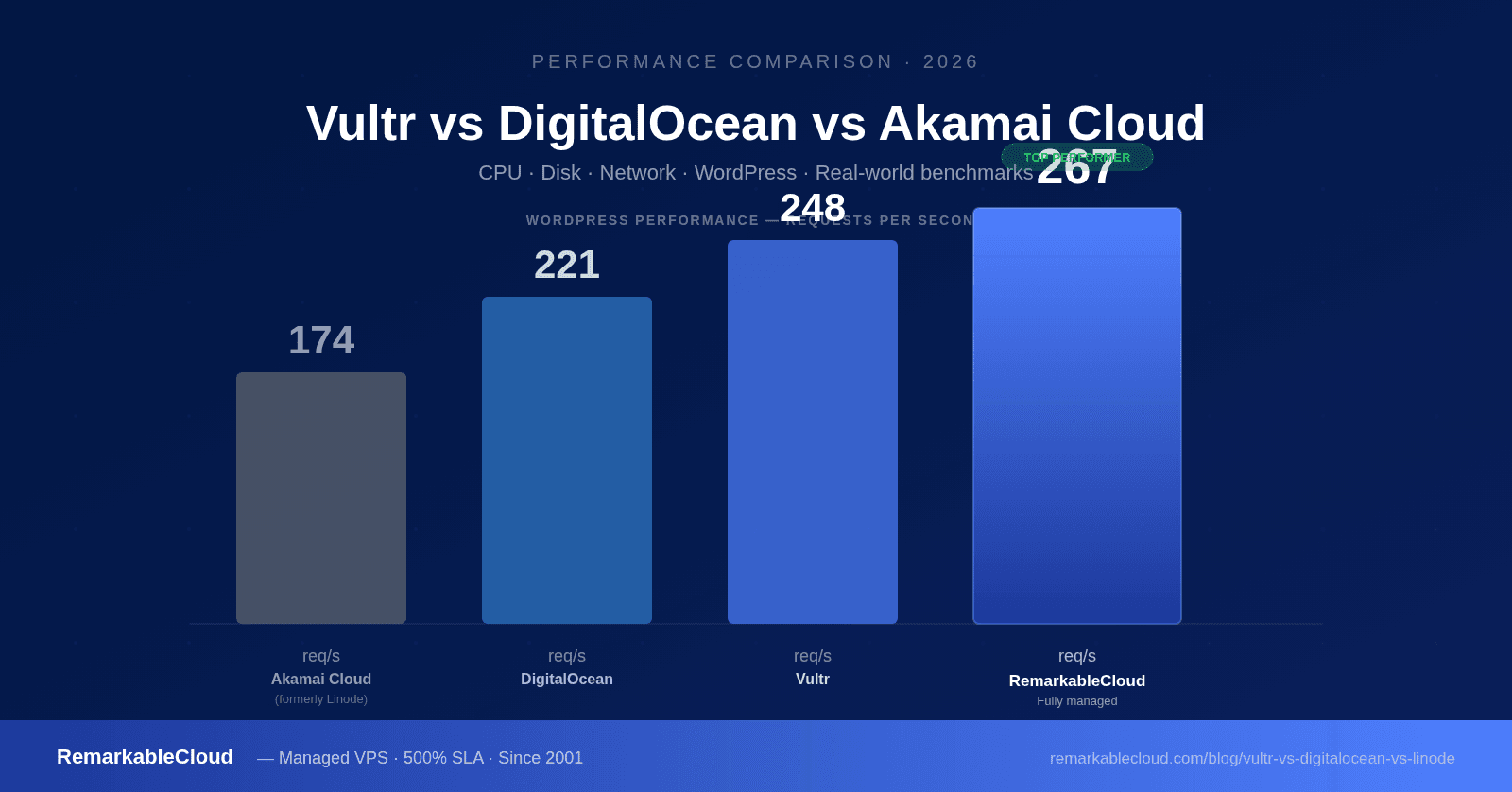
The benchmark that matters most for agencies and businesses. We tested a standard WordPress install with WooCommerce enabled, measuring average response time and requests per second under 50 concurrent users.
| Provider | Avg response time | Requests/sec |
|---|---|---|
| Akamai Cloud | 198ms | 174 req/s |
| DigitalOcean | 156ms | 221 req/s |
| Vultr | 142ms | 248 req/s |
| RemarkableCloud | 131ms | 267 req/s |
High-frequency CPUs and a tuned server environment make a direct difference for PHP and MySQL-heavy workloads. RemarkableCloud's managed configuration — LiteSpeed, optimized PHP-FPM, and OpCache — outperformed all three unmanaged providers on the WordPress benchmark.
Overall results summary
| Benchmark | Vultr | DigitalOcean | Akamai Cloud | RemarkableCloud |
|---|---|---|---|---|
| VM spin-up | 55s | 75s | 90s | N/A (managed onboarding) |
| CPU single-core | 1,842 | 1,614 | 1,590 | 1,897 |
| Disk write | 3,043 MiB/s | 2,563 MiB/s | 833 MiB/s | 3,280 MiB/s |
| Disk read | 9.2 GiB/s | 10.9 GiB/s | 6.1 GiB/s | 9.8 GiB/s |
| Network | 9.42 Gbps | 7.30 Gbps | 4.82 Gbps | 50 Gbps |
| WordPress req/s | 248 | 221 | 174 | 267 |
What the benchmarks don't show
Raw performance numbers matter. But all three of these platforms — Vultr, DigitalOcean, and Akamai Cloud — are unmanaged. That means the server is yours to operate in full:
- You configure and maintain the firewall
- You apply OS security patches as they're released
- You set up, test, and monitor backups
- You manage email deliverability — SPF, DKIM, DMARC, IP reputation
- You set up and respond to monitoring alerts
- You handle incidents at whatever hour they occur
- Support covers infrastructure — not your server configuration
For an experienced Linux sysadmin who wants full control, that's a reasonable trade. For a business or agency whose core work isn't server administration, that's 10–15 hours of operational overhead per month — minimum — plus the risk exposure of being on-call for your own infrastructure.
RemarkableCloud handles all of that on every plan. OS updates, security monitoring, backups, mail gateway, firewall, and 24/7 sysadmin support. 500% SLA — 1 hour down = 5 hours credited back automatically.
See what's included →Pricing: what you actually pay each month
The sticker price on unmanaged VPS is only part of the cost. Add a control panel, a mail gateway, and the time to operate the server, and the picture changes significantly.
| Provider | 1 vCPU / 2GB RAM | Control panel | Mail gateway | Management | Real cost/mo |
|---|---|---|---|---|---|
| Vultr | $12 | $20+ extra | $15+ extra | You | $47+ (+ your time) |
| DigitalOcean | $14 | $20+ extra | $15+ extra | You | $49+ (+ your time) |
| Akamai Cloud | $12 | $20+ extra | $15+ extra | You | $47+ (+ your time) |
| RemarkableCloud | $8 | Free (RemarkablePanel) | Free (MailChannels + Rspamd) | Fully included | $8 all-in |
Which provider should you choose?
Choose Vultr if:
- You need the fastest VM spin-up time for autoscaling or CI/CD
- Disk write performance is the primary bottleneck for your workload
- You're a developer who manages your own infrastructure and wants maximum control
- You need access to a large selection of global data center locations
Choose DigitalOcean if:
- Disk read speed is critical — caching layers, read-heavy databases, analytics
- You want the most beginner-accessible VPS with the cleanest documentation
- You're considering the Cloudways managed layer on top of DO infrastructure
Choose Akamai Cloud if:
- You need Akamai's edge network or CDN integration alongside compute
- You're already invested in the Linode/Akamai ecosystem
- A specific Akamai data center location is the deciding factor
Choose RemarkableCloud if:
- You want top-tier performance without running the server yourself
- You need control panel, mail gateway, backups, and monitoring included — not purchased separately
- You run WordPress, WooCommerce, or agency client sites that need to stay fast and available
- You want a 500% SLA and 24/7 sysadmin support — not just infrastructure helpdesk
- Your time is worth more than the difference in line-item pricing
Performance that manages itself
RemarkableCloud outperformed Vultr, DigitalOcean, and Akamai Cloud on CPU and WordPress benchmarks — with full server management, monitoring, backups, and mail gateway included on every plan. Starting from $2 your first month.
See all managed VPS plans